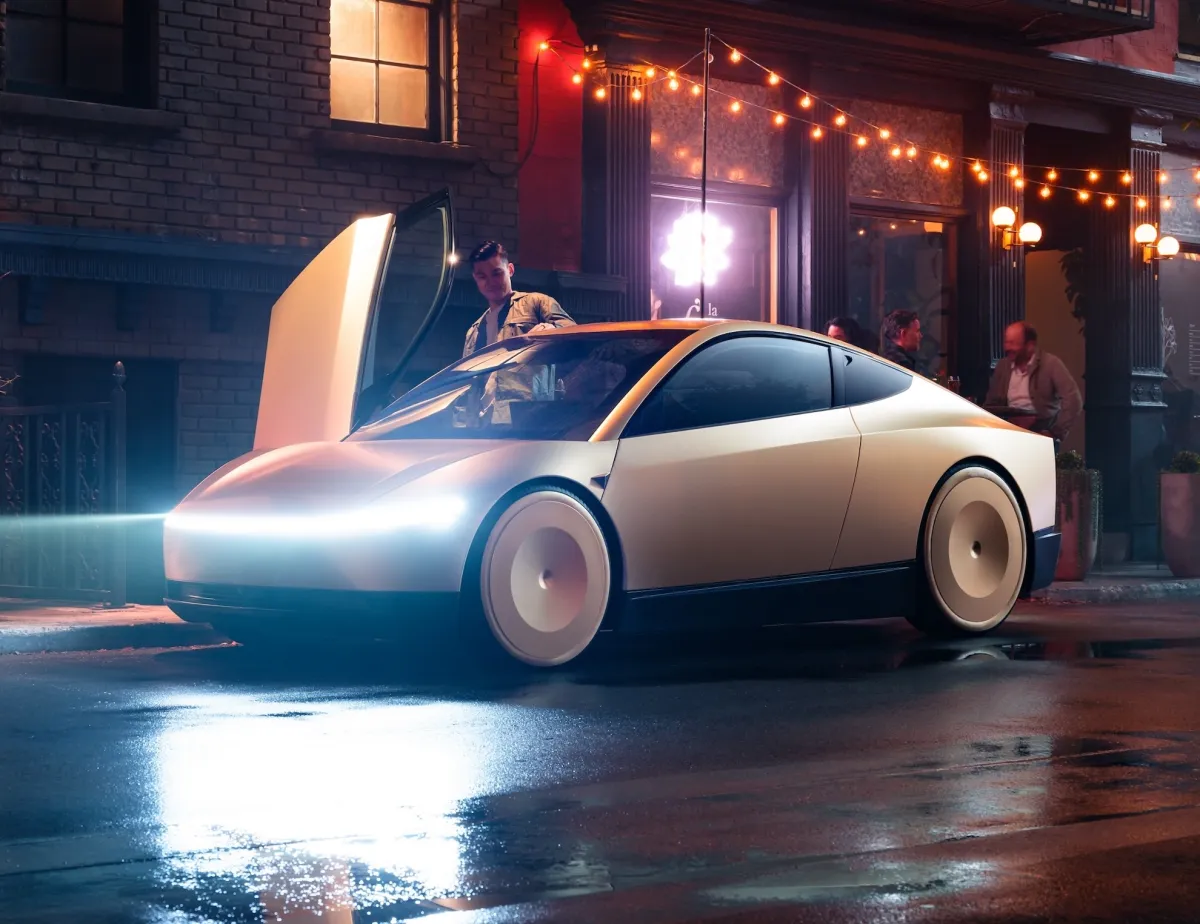
Tesla will kick off production of the Cybercab, an all-electric, autonomous vehicle with no pedals or steering wheel, this April at its Austin, Texas factory, CEO Elon Musk announced during the company’s shareholder meeting on Thursday.
Musk’s remarks about the Cybercab came right after shareholders approved a massive compensation package for him, potentially worth up to $1 trillion in company shares—making it the largest in corporate history.
“We’ve got the first car specifically designed for unsupervised, full self-driving, which we’re calling the Cybercab—it doesn’t even have pedals or a steering wheel,” Musk explained, noting there won’t be side mirrors either. “It’s optimized for the lowest cost-per-mile in autonomous mode, and production is happening right here in this factory. We’ll start production in April next year.”
Despite years of claims, Tesla has yet to prove that its cars can operate autonomously at scale without a safety monitor.
Musk’s statements appear to contradict comments made by Tesla chairwoman Robyn Denholm, who recently told Bloomberg that the Cybercab would feature a steering wheel and pedals as a backup. Tesla had initially considered including a steering wheel and pedals but scrapped that idea, choosing instead to produce very stripped-down models of its least expensive cars.
Musk further emphasized the production process, stating that the manufacturing line would have a 10-second cycle time—a significant improvement over the one-minute cycle time for assembling a Model Y. He projected that this efficiency could allow the production of 2 to 3 million Cybercabs each year.
“So these will be everywhere in the future,” he said.
Tesla first unveiled the Cybercab during its “We, Robot” event in October 2024 at Warner Bros. Discovery studio in California, with plans to eventually sell these vehicles for personal use.
Since then, Tesla has rolled out a limited robotaxi service, but not using the Cybercab. This service, which started in June in certain Austin areas, employs Model Y SUVs equipped with a new, “unsupervised” version of Tesla’s Full Self-Driving software. A Tesla employee is present in the passenger seat during these driverless rides.
Getting a Cybercab—or any vehicle—on the road without standard equipment like a steering wheel requires federal approval. Earlier this year, Amazon-backed Zoox managed to secure an exemption but has only been allowed to demonstrate its custom-built robotaxis on public roads. Zoox is still looking for an exemption to operate a commercial robotaxi service.
The regulatory process for these exemptions can be lengthy and complex. For instance, General Motors attempted to secure approval for its specially designed Cruise Origin vehicle but was unsuccessful. Meanwhile, Waymo, the leading robotaxi service provider in the U.S., continues to operate modified Jaguar I-Pace vehicles that still have traditional controls. Waymo is also collaborating with Zeekr to develop a new vehicle.
Musk didn’t seem worried about regulatory hurdles and expressed gratitude to Waymo for helping to “pave the path.”
“I think we’ll be able to deploy all the Cybercabs that we produce,” he said in response to a shareholder’s question during the annual meeting. “Once this becomes extremely normal in cities, there will be fewer and fewer reasons for regulators to say no.”