NASA’s James Webb Space Telescope Successfully Captures Direct Images of Exoplanet
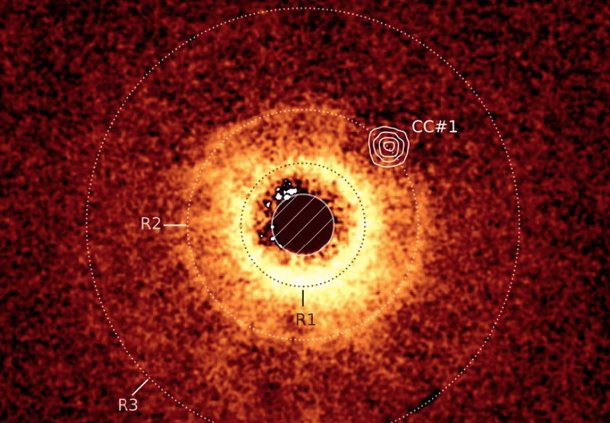
NASA’s James Webb Space Telescope (JWST) has made a groundbreaking achievement by successfully capturing direct images of an exoplanet for the first time. This significant milestone is noteworthy as exoplanets typically emit very little light, making their detection challenging. Traditionally, researchers have relied on indirect methods, such as observing the dimming of stars as planets transit across them.
Discovery of TWA 7 b: A New Insight into Exoplanets
The celestial body identified is known as TWA 7 b, a planet that is approximately the size of Saturn and situated around 100 light-years from Earth. Notably, TWA 7 b resides at a distance from its star that is far greater than that of Earth’s orbit. This extended separation results in an orbital period that spans several hundred years. The system in which TWA 7 b exists is estimated to be about 6 million years old, offering a glimpse into the early developmental stages of planetary formation—contrasting with our Sun, which is approximately 4.6 billion years old.
Innovative Techniques in Exoplanet Imaging
According to reports from The Guardian, TWA 7 b is ten times smaller than any previously observed exoplanet through direct imaging. This size typically renders planets nearly invisible to telescopic observation due to the bright light emitted by their host stars. Overcoming this challenge, the research team, directed by Dr. Anne-Marie Lagrange, developed a telescopic attachment that simulated the effects of a solar eclipse. This innovative method effectively reduced the starlight, allowing the team to more clearly observe surrounding celestial objects.
The findings indicated the planet as a luminous point in the images, accompanied by a narrow ring of debris. While Lagrange and her colleagues acknowledge a minimal possibility that the images could depict a background galaxy, the evidence significantly indicates the presence of an undiscovered planet.
Milestones in Exoplanet Research
Since the first exoplanet was documented in 1992, scientists have identified nearly 6,000 additional exoplanets, with the majority detected through indirect imaging techniques. The recent achievement by the James Webb Space Telescope represents a pivotal advancement in this field of study.
In addition to this landmark exoplanet discovery, JWST recently captured an extraordinary cosmic phenomenon known as an "Einstein Ring," illustrating the bending of light from one galaxy around the gravitational mass of another galaxy. This telescope has also made headlines with its discovery of the most distant galaxy ever recorded.
Conclusion
The direct imaging of TWA 7 b by the James Webb Space Telescope marks an exciting new chapter in exoplanet research. As scientists deepen their understanding of planetary systems, this breakthrough promises to unlock further mysteries of the universe.
By leveraging advancements in technology and innovative imaging techniques, NASA continues to push the boundaries of space exploration and discovery.