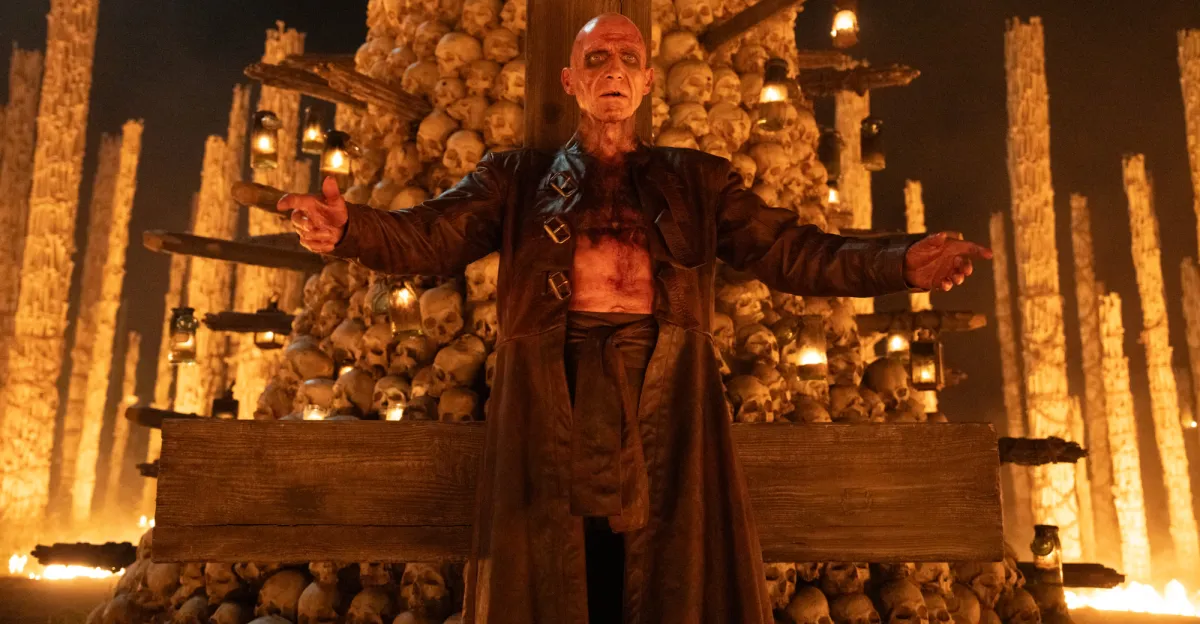
Because there was such a long gap between the releases of 28 Weeks Later and 28 Years Later, it was a pleasant surprise to hear that writer-director duo Alex Garland and Danny Boyle had plans for their latest project to kick off a new horror trilogy. Sony seemed eager to get things moving quickly, as shooting for 28 Years Later and its sequel began back-to-back. However, it felt like the studio wanted to infuse a fresh vibe into the franchise by bringing in Nia DaCosta as the director.
That unique energy and divergence from Boyle’s direction is evident in 28 Years Later: The Bone Temple—a film that recognizes how much more impactful horror can be when it’s sprinkled with humor. While the film delivers plenty of gore and gut-wrenching violence, its incorporation of comedy cleverly highlights what the characters are truly fighting for. Each laugh serves as a reminder that even in a world infested with flesh-eating ghouls, human connections and community are worth fighting for.
The Bone Temple picks up shortly after 28 Years Later, introducing us to teenager Spike (Alfie Williams) as he grapples with his new life as part of Sir Lord Jimmy Crystal’s (Jack O’Connell) motley crew of platinum blonde wig-wearing cultists, all called "Jimmy." Spike can hold his own against a few infected prowling the English wilderness, but his archery skills pale in comparison to the Jimmys’ brutal way of tackling anything in their path.
Murdering people—infected or otherwise—at Jimmy Crystal’s behest has become second nature for Jimmy Ink (Erin Kellyman), Jimmima (Emma Laird), and their deranged associates. Spike struggles to take Jimmy Crystal’s claims of divine guidance seriously, but he knows he has no choice but to fit in and wear outlandish attire when asked to join their ranks.
Through the Jimmys, 28 Years Later explores how faith can be warped to harm those it is supposed to comfort. The Jimmys form a twisted family, bonded by genuine affection for one another and the understanding that safety comes in numbers. However, the movie presents their loyalty to Jimmy Crystal as stemming from fear and a vulnerability that has emerged from society’s breakdown.
One of the standout elements of O’Connell’s portrayal is how he injects a sense of vulnerability into the character of Jimmy Crystal. Even amid his psychopathy and delusions, O’Connell reveals a scared boy trapped within a disturbed man. This duality is highlighted by Jimmy’s frequent, amusing references to the Teletubbies and his insistence that Satan, his father, is whispering directives to him. His delusional rants are all too believable to his young followers, who have grown up in a world scarce of level-headed authority figures. However, his theatrics fall flat when directed at older individuals like Dr. Ian Kelson (Ralph Fiennes), who possesses more life experience and memories of the world before the plague.
It’s through Kelson that The Bone Temple starts to raise intriguing questions about the infected, including Samson (Chi Lewis-Parry), the towering Alpha introduced in 28 Years Later. The sequel dives deeper into these returning characters’ lives, shedding light on their transformations through their interactions. Fiennes and Lewis-Parry are extraordinary, bringing both humor and unexpected warmth as Kelson and Samson draw closer in ways that are surprising and sometimes alarming. Their chemistry serves as a vehicle to remind us about what humanity has lost in the 28 years since the Rage outbreak.
While 28 Years Later felt like a response to zombie narratives influenced by 28 Days Later, The Bone Temple draws its inspiration from the broader undead canon. DaCosta amplifies scenes featuring Samson’s relentless hunt for flesh with haunting moments of stillness and tight, unsettling shots of him cracking open skulls to feast on brains. Within the film, Samson represents a new breed of infected—one with intelligence and social skills. However, he also pays homage to the shambling corpses that made George Romero a cinematic legend.
Although DaCosta inherited much of the story from Boyle and Garland’s previous collaboration, she makes it uniquely her own with a less frenetic visual style. Some of the movie’s most effective scares arise from their gradual reveal. Just as the tension peaks, DaCosta skillfully alleviates it with perfectly timed music selections.
Initially, it was tough to envision how 28 Years Later could develop into a captivating trilogy. However, The Bone Temple clearly shows that Boyle and Garland have been brewing something special since the start of this new chapter in the franchise. DaCosta expertly lays the groundwork for promising developments in the trilogy’s conclusion, which will see Boyle return to tie it all together. If the next installment can capture a similar vibrancy for the undead genre, the wait will surely be worthwhile.
28 Days Later: The Bone Temple also stars Louis Ashbourne Serkis, Maura Bird, Ghazi Al Ruffai, Sam Locke, and Cillian Murphy. The film is set to hit theaters on January 16th.