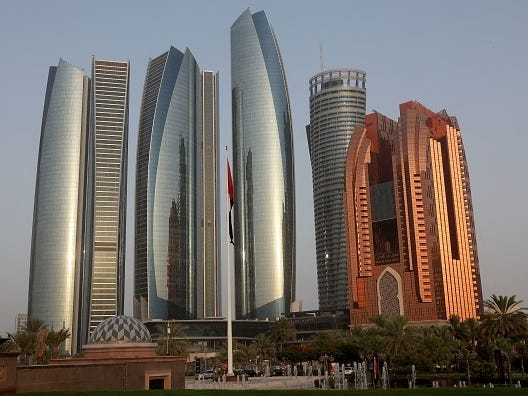
- The United Arab Emirates aims to be a frontrunner in artificial intelligence by 2031.
- It’s leveraging its oil wealth to attract new talent and fund new research initiatives.
- The UAE’s AI minister believes we’ll have “centers and nodes of excellence across the world.”
The AI revolution is expanding far beyond Silicon Valley.
From the
shores of Malta
In the streets of Paris, centers for AI innovation are cropping up globally. The United Arab Emirates is becoming a crucial hub in the Middle East, largely due to substantial investments initiated under U.S. President Donald Trump’s administration.
This past week, as part of his trip through the Middle East, Donald Trump facilitated agreements between the U.S. and the UAE worth up to $200 billion in business transactions, as stated by the White House. Additionally, both nations inked a pact allowing the UAE to construct what will become the biggest artificial intelligence hub outside the United States. This arrangement grants the UAE greater opportunities to obtain advanced AI hardware. The new contract represents significant progress for the area compared to when Joe Biden was president because they faced tighter restrictions on chip imports owing to their connections with China.
The UAE has consistently made its mark on the AI landscape.
In October, the UAE made headlines by participating in the most lucrative funding round in Silicon Valley history: the $6.6 billion
deal closed by OpenAI
The investment was conducted via MGX, a government-supported tech company specializing in artificial intelligence and semiconductors.
This initiative is part of the UAE’s strategy to emerge as a leading force in artificial intelligence by 2031 via various efforts including strategic programs, community involvement, and financial investments in research. In the previous year, Abu Dhabi, which is the nation’s richest emirate, introduced Falcon—a pioneering open-source large language model. Additionally, G42, an AI company supported by the state, is working on developing extensive language models for both Arabic and Hindi. This effort aims to connect non-English speaking populations with more relevant linguistic resources.
A further sign of the UAE’s dedication to artificial intelligence is the selection of Omar Sultan Al Olama as the nation’s AI Minister back in 2017.
In a video interview with the Washington D.C.-based think tank Atlantic Council, the minister admitted that the UAE confronts intense rivalry from major players such as the U.S. and China. According to data from Stanford’s Center for Human-Centered Artificial Intelligence, private investments in AI technology amounted to $67.2 billion in the U.S. and $7.8 billion in China in 2023.
In the video, he said he is embracing cooperation over competition.
“I don’t believe this will turn into a zero-sum scenario where development in AI happens exclusively within the U.S., China, or the UAE,” Al Olama stated during an event organized by the Atlantic Council, a Washington D.C.-based think tank, in April. “Instead, what I foresee is the emergence of global hubs and specialized areas of expertise. These will cater to particular applications or sectors wherein one nation, entity, or corporation outperforms others.”
The UAE is one of the wealthiest countries in the world, mostly due to its vast oil reserves. The UAE is among the world’s 10 largest oil producers, with 96% of that coming from its wealthiest emirate, Abu Dhabi,
according to the International Trade Administration
.
The ruling family of Abu Dhabi also oversees some of the biggest global entities.
sovereign wealth funds,
including entities like the Abu Dhabi Investment Authority and Mubadala Investment Company, which is a founding partner of MGX.
This money has been allocated to broaden the nation’s reliance on oil revenues and might now be redirected towards supporting emerging AI enterprises. By 2030, AI has the potential to add approximately $96 billion to the UAE’s economy, accounting for around 13.6% of its total GDP, as stated in a report.
report
by PwC, the auditing company.
But capital is only part of the equation. The bigger question is whether the tiny Gulf nation can attract the requisite talent to keep up with Silicon Valley.
Recent advancements indicate potential. From 2021 to 2023, the number of AI employees in the UAE increased fourfold to reach 120,000, as mentioned by Al Olama during the Atlantic Council event. The country introduced an ‘elite visa’ scheme for tech specialists back in 2019, simplifying access for AI professionals. Additionally, they are fully utilizing their current workforce. For instance, in May, Dubai initiated a new program
the largest global effort in prompt engineering
The objective is to enhance the skills of 1 million employees within the coming three years.
Nevertheless, the country has encountered criticism regarding worker treatment, particularly affecting low-skilled migrant workers who make up 88% of the populace. These migrants often face various labor violations such as excessive heat exposure, exorbitant recruitment charges, and unpaid wages, as reported by Human Rights Watch. In response, the UAE has enacted multiple labor regulations aimed at safeguarding employees concerning working hours, compensation, and fair practices.
In the past ten years, Abu Dhabi has emerged as a hub for artificial intelligence research and learning.
In 2010, New York University launched a branch in Abu Dhabi that has since developed a focus on AI. And, in 2019, Mohamed bin Zayed University of Artificial Intelligence opened as a “graduate research university dedicated to advancing AI as a global force for good.” Professors from the university also helped organize the inaugural
International Olympiad in Artificial Intelligence
In August, this event attracted students from more than 40 countries around the globe.
“Abu Dhabi may not directly surpass Silicon Valley, however, it has the potential to become a significant AI hub in its own right,” Nancy Gleason, an advisor to leadership on AI at NYU Abu Dhabi and a professor of political science, told Business Insider by email. Its “true strengths lie in the leadership’s strategic vision, substantial investments in AI research and compute capacity, and government-led initiatives in industry. The UAE has also made strategic educational investments in higher education like the Mohamed bin Zayed University of Artificial Intelligence and NYU Abu Dhabi.”
Beyond that, she noted, it’s “very nice to live here.”
If you enjoyed this story, be sure to follow
Business Insider
on MSN.