A week ago, Tesla’s Optimus robot captured attention with its impressive dance routine. This week, the focus shifts to the bot’s ability to perform everyday tasks, showcasing its capabilities with remarkable skill for a humanoid robot.
### Recent Demonstrations
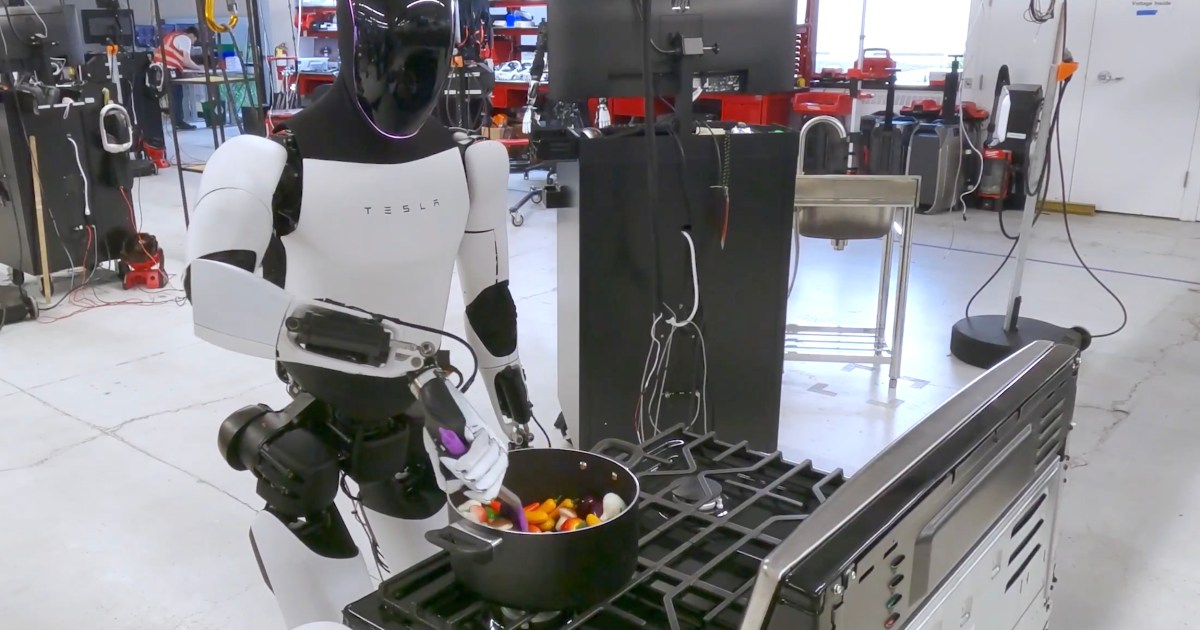
In a newly released video, the “Tesla bot” is seen executing various tasks as directed by natural language instructions. These activities include disposing of trash, cleaning food debris off a table using a dustpan and brush, tearing off a section of paper towel, stirring a pot, and vacuuming the floor, among other functions.
While these demonstrations may not revolutionize the field of humanoid robotics, they nonetheless highlight the steady advancements being made by Tesla engineers. The complexity of the bot’s movements and actions is steadily increasing.
### Insights from the Team
Milan Kovac, the head of the Optimus team, shared insights about their progress in a post on X. He noted, “One of our goals is to have Optimus learn directly from internet videos of humans performing tasks.” It’s important to clarify that this does not imply the robot will view videos as humans do. Rather, the intention is for the robot to analyze the extensive data present in these videos, which includes demonstrations of different tasks, movements, and behaviors.
According to Kovac, the team has recently achieved a “significant breakthrough” that allows for the transfer of a substantial portion of learning from human videos directly to the bots, starting with first-person perspectives. This advancement facilitates quicker acquisition of new tasks compared to relying solely on data from operations performed by a human-controlled bot.
### Future Developments
Looking ahead, the plan for Optimus involves enhancing its reliability by enabling it to practice tasks independently, whether in real-world scenarios or through simulations. This will be achieved using reinforcement learning, a method that refines actions via trial and error.
Elon Musk, the CEO of Tesla, has been vocal about the potential of Optimus since its announcement in 2021. He envisions a future where “thousands” of these robots could be utilized in Tesla factories alongside human employees, taking on “dangerous, repetitive, and boring tasks.”
### Industry Context
Tesla, traditionally recognized for its electric vehicles rather than humanoid robots, is competing against a growing number of technology companies around the globe. Many of these firms are eager to commercialize their own humanoid robots for various applications, including workplace integration, domestic use, and potentially entirely new types of human-robot ecosystems that remain to be conceived.
### Conclusion
The progress demonstrated by Tesla’s Optimus robot reflects not only the technical achievements within the company but also the broader landscape of humanoid robotics. As competition intensifies among tech companies, the developments at Tesla may influence the trajectory of the industry as a whole. With ongoing improvements and the integration of advanced learning methodologies, Optimus stands as a significant player in the evolution of robotics, aiming to transform both workplace dynamics and everyday life.