In an age when sustainability is often sold with more sizzle than substance, one
legacy aerospace technology
is quietly floating back into relevance, if it can prove itself in the harsh arena of free market economics.
Airships — yes, giant zeppelins — are making a cautious comeback, but their future, says historian and author John J. Geoghegan, rests not on nostalgia or novelty, but on cold, hard business.
Speaking to FOX Business in an exclusive interview, Geoghegan, author of ”
When Giants Ruled the Sky
” and professor at the University of San Francisco, offered a clear-eyed assessment of the burgeoning airship renaissance led by deep-pocketed tech backers and sleek PR.
“At the end of the day, it will be up to the markets. And the markets are hard-nosed,” Geoghegan said. “You have [lighter-than-air] enthusiasts out there who would love to see these things flying around the sky again. But, at the end of the day, it’s all gonna be up to the capitalist system of profit and loss.”
HYBRID AIRSHIP SLASHES EMISSIONS BY 80%
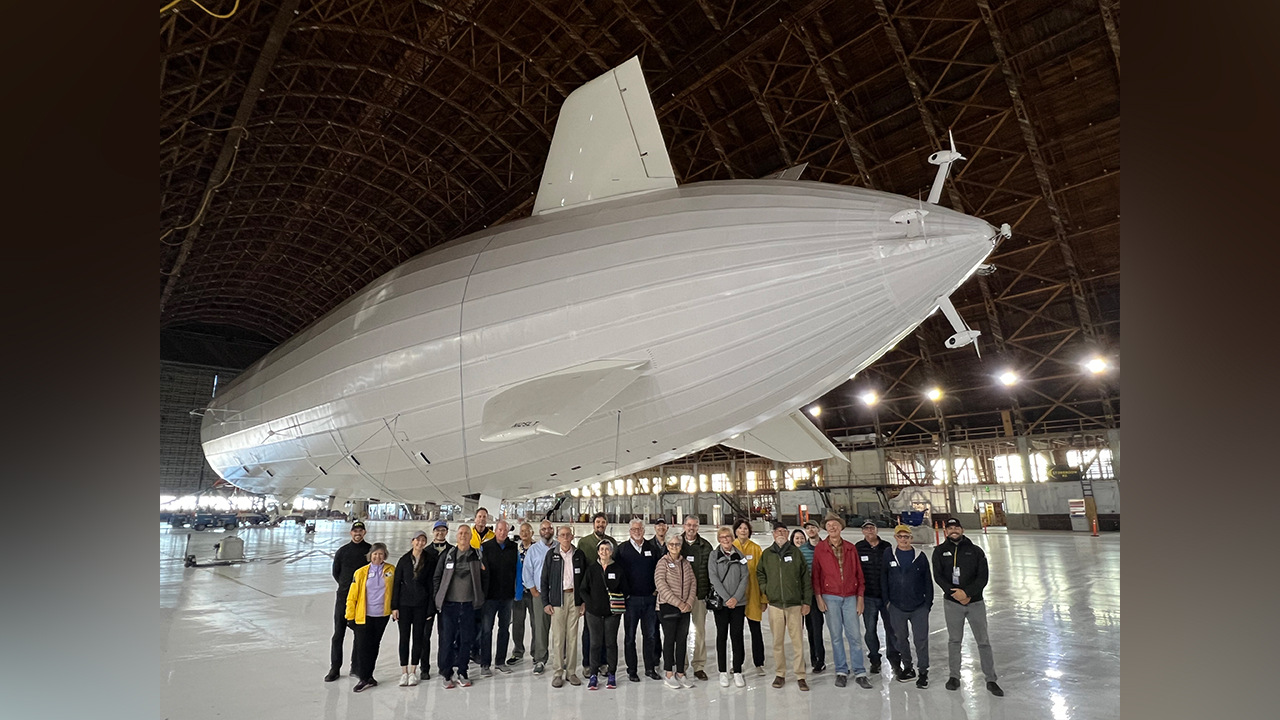
The clearest sign of life in the airship sector comes from Mountain View, California, where LTA Research, bankrolled solely by Google co-founder Sergey Brin, is quietly testing its 400-foot “Pathfinder 1,” with plans to build a full-size zeppelin next.
Pathfinder 1 achieved its first untethered outdoor flight in October 2024 at Moffett Federal Airfield, marking a significant milestone in the revival of American airship technology. This fully electric airship
combines advanced materials
like carbon fiber and titanium with twelve electric motors and a fly-by-wire system.
READ ON THE FOX BUSINESS APP
“This is a self-funded airship. It’s not beholden to investors. Sergey is the one who wants to build this thing, and he can afford it,” Geoghegan explained. “He’s like Jeff Bezos or Elon Musk. His passion is not Mars
or suborbital flights.
It’s lighter-than-air flight.”
Geoghegan didn’t hold back his admiration for LTA Research’s Pathfinder 1.
“It is a romantic experience. You know, they’re quiet. They’re smooth. You almost don’t even realize you’re moving. And to be in a whale-size … aircraft floating and bobbing, you know, quietly through the sky, it is a remarkable sensation.”
That sense of wonder, he noted, is part of the appeal, but whether romance can translate into revenue is a different question entirely.
MASSIVE AIRSHIP COULD SHAKE UP CARGO TRANSPORT

This kind of single-source funding removes the usual investor pressures but does little to address the ultimate question of who’s buying?
While past attempts at resurrecting airships have deflated, this time around companies like Britain’s Hybrid Air Vehicles are targeting an ultra-premium niche.
Across the Atlantic, HAV is developing the Airlander 10, a hybrid airship that merges aerodynamic lift with helium buoyancy.
Originally designed for the U.S. Army’s Long Endurance Multi-intelligence Vehicle (LEMV) program, the Airlander 10 has been repurposed for civilian applications, including regional passenger transport, luxury tourism and cargo delivery. HAV plans to commence production of up to 24 units annually by 2030 at a new factory in Doncaster, aiming to create over 1,200 jobs and contribute to sustainable aviation efforts.
“They’re not looking at a jumbo jet 747-type configuration,” Geoghegan said. “They’re talking about 50 people, maybe fewer, with glass-bottom floors and $5,000 ticket prices.”
“The Concorde flew for 20 years. It lost money, but people paid for speed. With airships, you’re paying for luxury and the uniqueness of the experience,” he added.
That market, however, is small and speculative.
Individuals won’t travel to work using those,” Geoghegan stated bluntly. “No one has ever come up with a genuine business strategy for implementing short-distance commuter services via airships.
The public’s recollection, influenced more by newsreels than statistics, persists in remembering the dramatic end of the Hindenburg. However, Geoghegan swiftly sets the record straight.
He mentioned that two out of every three passengers and crew members survived the accident. Remarkably, the combined fatalities from all Zeppelin disasters are fewer than those lost in the U.S. over a single holiday weekend.
Even now, people traverse the sea aboard ships, but they hesitate to step onto an airship. This perception is flawed.
Despite being in its 100th year, even the Goodyear Blimp maintains an impressive safety record. Nevertheless, the negative perception persists.
Even with advancements in carbon-kevlar building materials and electric engines, one persistent issue continues to be helium.
Helium comes at a high cost. In contrast, using hydrogen proves both less expensive and more efficient,” remarked Geoghegan. “However, due to the Hindenburg incident, nobody wants to consider hydrogen anymore.
He downplayed alarmist fears over helium scarcity.
He believes that this is often overstated,” he cautioned, emphasizing that unpredictable prices might destabilize the economic viability of airships. “This significant variable has the potential to impact their entire business strategy.
While some pitch airships as a solution for remote cargo delivery, Geoghegan said he doesn’t buy the hype.
“If you’re carrying a three-ton wind turbine blade and drop it at its location, your aircraft just lost three tons. It’s going to shoot up into the air,” he said. “No one has figured out how to solve that basic physics problem.”
Plus, traditional cargo aircraft already serve this market well. “They’d have to underprice to compete, and I’m not sure they can.”
GET FOX BUSINESS ON THE GO
For now, Geoghegan remains “cautiously optimistic,” singling out just two companies, LTA Research and HAV, as worth watching.
“If they can’t do it, then nobody can,” he said.
LTA Research declined to provide an interview to FOX Business. Hybrid Air Vehicles did not immediately respond to FOX Business’ request for comment.
Original article source:
‘Romantic’ versus reality? Zeppelin travel, which offers a weightless experience, might take off if the market approves.