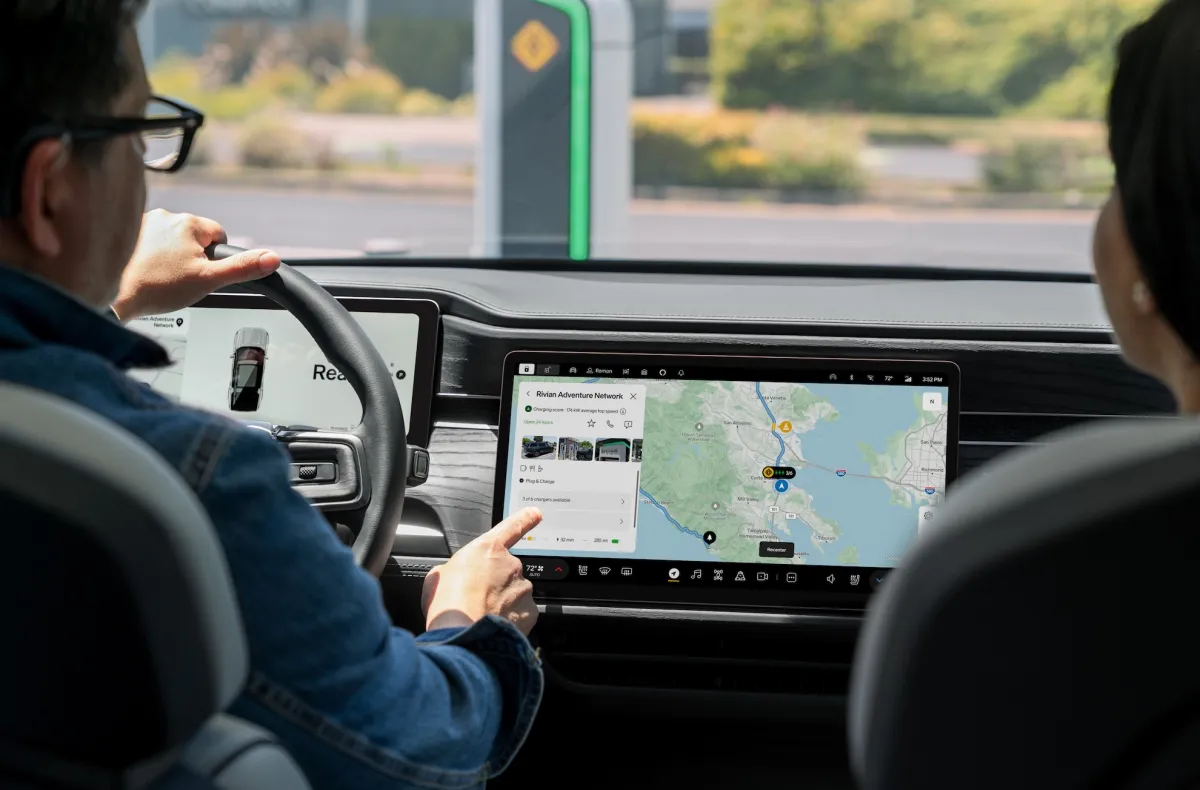
Rivian has dedicated nearly two years to developing its own AI assistant, continuing independently from its billion-dollar tech partnership with Volkswagen, according to TechCrunch.
While Rivian hasn’t disclosed a specific launch date for the AI assistant, their software chief, Wassym Bensaid, mentioned earlier this year that they’re aiming for a release by the end of the year. More details are likely to come at their upcoming AI and Autonomy Day, which will be live-streamed starting at 9 a.m. PT on December 11.
Rivian’s strategy mirrors the current trend of rapid advancements in foundational AI, with major technology firms and startups, including Anthropic, Google, Microsoft, Meta, and OpenAI, speeding up development. Industries are racing to keep pace.
However, as Bensaid emphasized in a past interview, this initiative isn’t just a rushed attempt to hop on the AI bandwagon. It goes beyond simply adding a chatbot to the infotainment system. The company has invested significant time, thought, and resources into this project, aiming for it to be integrated with all vehicle controls.
The team began with a philosophy to create a model and platform-agnostic architecture. Based in Palo Alto, they quickly recognized the need to focus on developing software layers that coordinate various workflows and control logic to address potential conflicts.
“That’s the in-vehicle platform we have built,” Bensaid explained. “We use what the industry now likes to call an agentic framework; we conceptualized that architecture from the early stages to enable interaction with different models.”
Rivian’s in-house AI assistant program aligns with its broader goal of vertical integration. In 2024, the company revamped its flagship R1T truck and R1S SUV, modifying everything from the battery pack and suspension to the electrical architecture, sensor stack, and software user interface.
The company is also heavily investing in developing its software stack, managing key components like real-time operating systems (RTOS) for thermal dynamics, advanced driver-assistance systems (ADAS), and safety protocols, as well as an additional layer for the infotainment system.
Although Bensaid withheld specific details about the AI assistant, he mentioned it includes a mix of models tailored for various tasks. This results in a hybrid software stack that utilizes edge AI for on-device processing and cloud AI for handling larger, more complex models on remote servers.
The intent is to create a flexible, customized AI assistant that balances workloads between local and cloud processing.
Rivian has primarily developed its AI software in-house, including custom models and an “orchestration layer” that ensures different AI models operate in harmony. They have also collaborated with other companies for specific agentic AI functions.
Bensaid highlighted that their goal is to create an AI assistant that fosters customer trust and engagement.
At this stage, the AI assistant is being kept within Rivian. While their joint venture with Volkswagen focuses on software, it’s not aimed at developing an AI assistant or automated driving systems.
The partnership, established in 2024 and valued at up to $5.8 billion, centers around the underlying electrical architecture, zonal computing, and infotainment systems. Kicking off in November 2024, it’s expected to supply Volkswagen Group with its electrical architecture and software by as early as 2027.
For now, autonomy and AI are separate, but Bensaid noted, “That doesn’t mean it won’t be integrated in the future.”