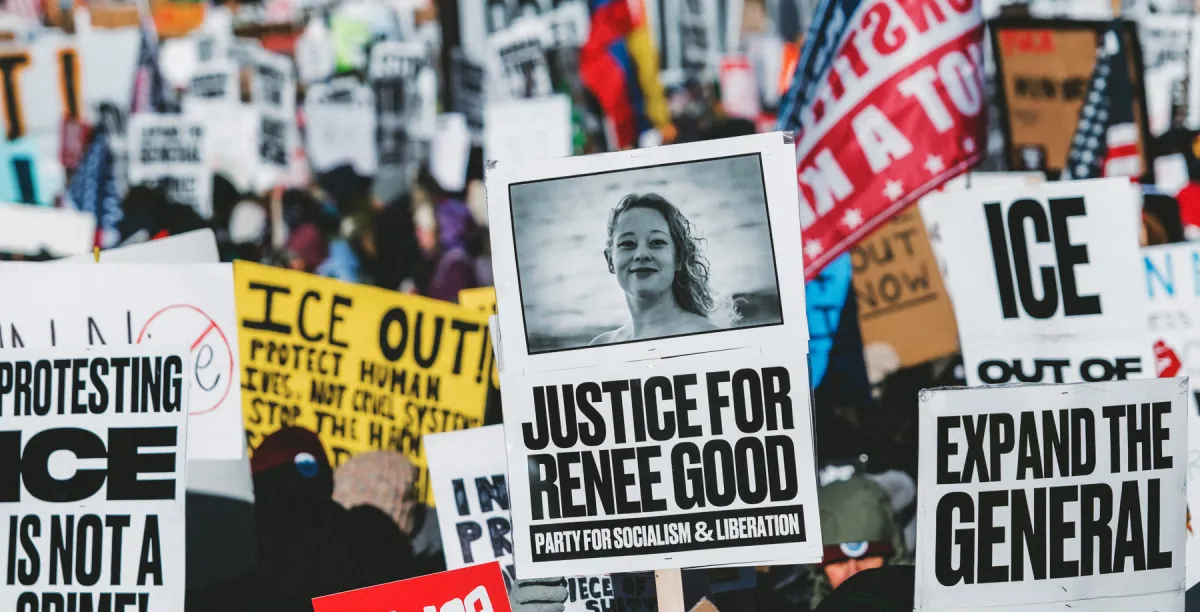
It was too chilly to remove my mittens and check Google Maps, so I decided to follow the group of bundled-up individuals ahead of me. They were all carrying signs and sporting whistles around their necks, layered in winter clothing. Initially, there were just a few dozen of us heading to Government Plaza, right across from Minneapolis City Hall, but by the time I arrived, we had swelled into a crowd of thousands. Some estimates suggested five to ten thousand participants, but on the ground, it felt like a singular, pulsating mass, far too vast to count.
As I navigated through the crowd, I kept saying “excuse me” and “pardon me” over the noise because everyone here was incredibly polite. One person offered me a “Fuck ICE” pin, another handed me a chocolate-chip cookie, and a third presented me with a red vuvuzela. All three opted out of being named or interviewed.
On Friday, January 30, this marked the second general strike in the Twin Cities since federal immigration officials took the life of Alex Pretti. This particular event was reportedly organized by Somali and Black student groups from the University of Minnesota. Unlike the first strike held the previous week, which gained support from local unions, this one was pulled together more hastily. I caught wind of lower turnout this time around, but it was hard to reconcile that with the fact that the plaza was packed to the brim, leaving me baffled about how more people could possibly join. Yet, more Minnesotans kept arriving. When the light-rail train rolled in, I noticed people inside standing shoulder to shoulder, and they poured out to fill any available space.
They began chanting: “No more Minnesota nice, Minneapolis will strike.”
The atmosphere at the City Hall rally was almost jubilant, a stark contrast to the ongoing protests outside the Whipple Federal Building, the staging area for ICE agents who hunt down immigrants in unmarked cars. While that location was rife with tension and hostility, with jeers aimed at federal agents and local sheriffs often resulting in flashbangs and pepper spray, today, there seemed to be less immediate danger at the City Hall rally. Still, the people of Minneapolis were acutely aware that peril lurked everywhere. You could be sitting in your car, be killed by a federal agent, or just doing an ICE watch and face the same fate. Even protesting against such violence could lead to arrest by federal agents. Whether walking or driving to work, the threat was very real. You might blow a whistle to alert neighbors about a possible abduction by federal agents and, at the very least, end up pepper-sprayed.
Medics were moving around, ready for anything. Helicopters buzzed overhead. Volunteer marshals in neon vests were stationed at nearly every entrance and street corner, guiding the crowd. One marshal warned me about the ice; I didn’t catch her warning and slipped, but thankfully, a woman behind me caught my fall.