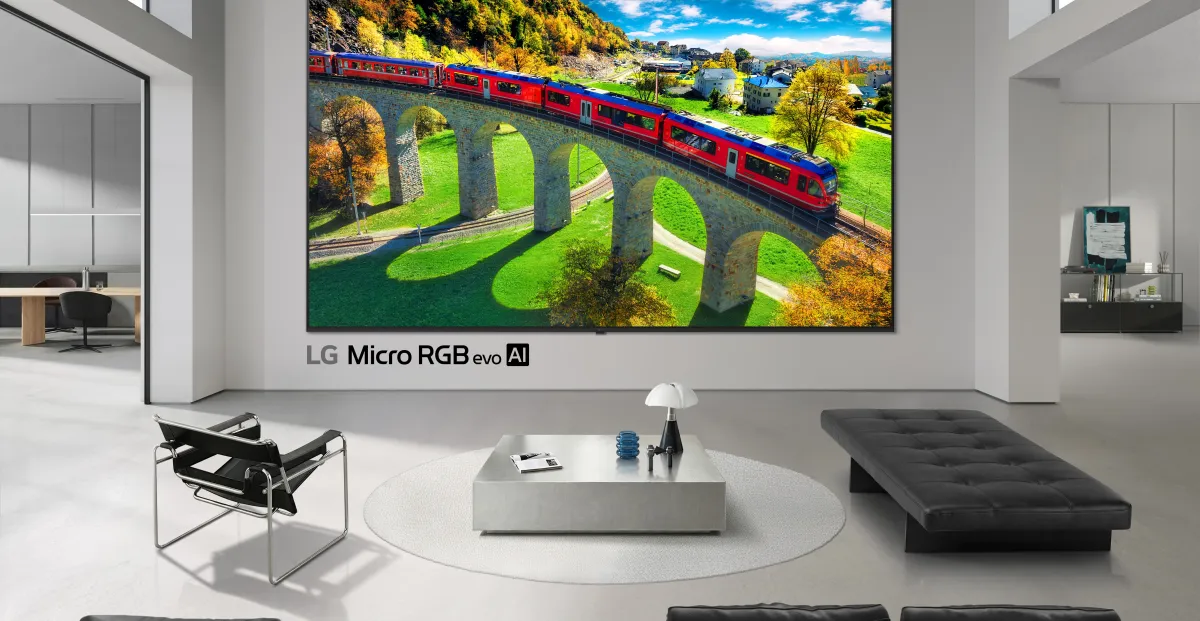
In what looks to be the start of many announcements, LG has confirmed that it will launch its first flagship RGB TV in 2026. This wasn’t much of a secret, especially since a “premium LCD TV with Micro RGB technology” won a CES 2026 Innovation Award back in November. Now it’s official that the LG Micro RGB evo TV will be available in 100-, 86-, and 75-inch sizes, with pricing details for the US set to be announced later.
The Micro RGB evo TV will feature an upgraded version of LG’s Alpha 11 processor, which is typically found in the company’s high-end OLED models like the LG G5. Intertek, a testing and certification company, has certified the TV to achieve 100 percent gamut coverage of BT.2020, DCI-P3, and Adobe RGB color spaces. No information is available yet on its brightness levels, but I expect the brightest highlights to easily exceed 5,000 nits.
CES—and 2026 overall—seems poised to be the year of the RGB TV, with more companies expected to unveil flagship models featuring this technology. This trend kicked off when Hisense introduced the 116-inch 116UX at CES 2025, while Samsung showcased its 115-inch Micro RGB TV, which launched last August. It’s likely that we’ll see more offerings and smaller sizes to compete with the upcoming LG Micro RGB when CES rolls around this January. During my visit with Samsung in August to check out its Micro RGB TV, a representative mentioned, “We have exciting things ahead for Micro RGB.”
It’s crucial to understand that micro RGB technology differs from microLED, which utilizes microscopic red, green, and blue LEDs for each pixel. The RGB technology being implemented by LG (and in other instances by Samsung, Hisense, and eventually Sony and TCL) utilizes clusters of red, green, and blue LEDs to provide light for multiple pixels at once. These LEDs are still incredibly small—hence the term “micro”—offering improved gamut coverage and color purity, but the TV still requires a color filter to accurately produce color for each pixel. The LED displays we’re all familiar with typically use either a blue or white backlight.
So far, the versions of RGB LED technology from Hisense and Samsung have been exceptionally impressive, delivering punchy, vibrant images that surpass anything currently on the market. However, these have mostly been large TVs priced in the tens of thousands of dollars — not something most of us are likely to place in our homes. Now that each TV manufacturer appears to be launching its own versions in smaller sizes, we can hope for prices to drop to more attainable levels.