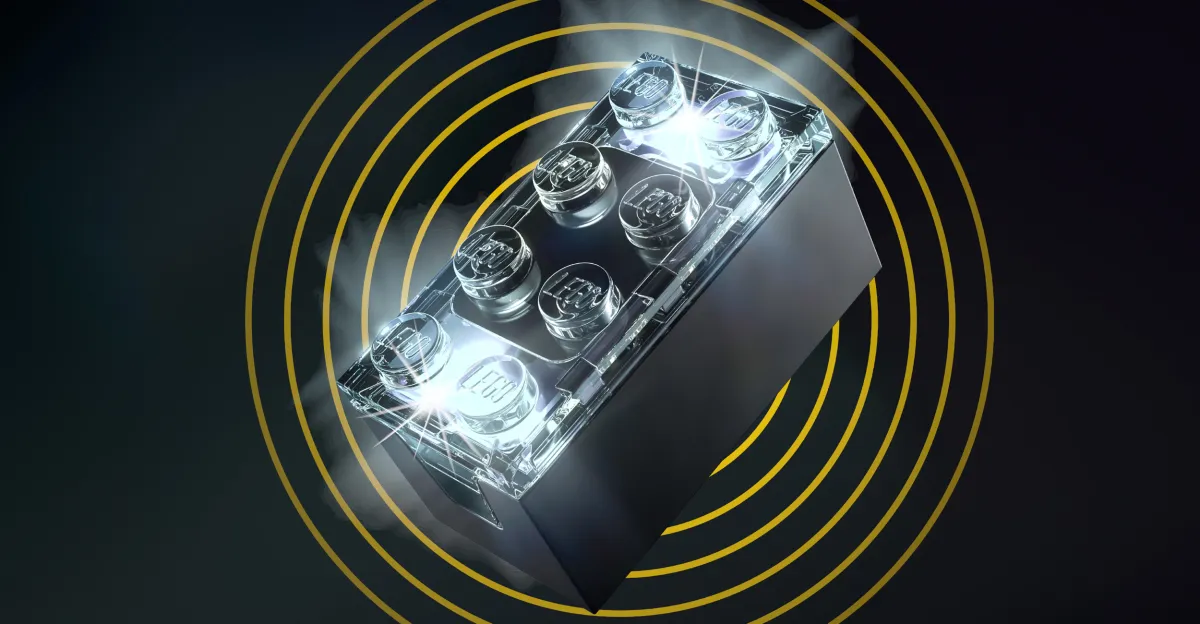
On March 1, 2026, The Lego Group plans to launch its most innovative product yet: a tiny computer nestled inside a classic 2×4 Lego brick. This smart brick will interact with NFC-equipped smart tags found in new Lego tiles and minifigures, bringing entire Lego sets to life. The first wave of this exciting technology will kick off with features from Lego Star Wars, including lightsaber sounds, roaring engines, illuminated blasters, and background music.
These new “Smart Bricks” are a significant step up from the previous Lego Mario sets, which required batteries and mainly relied on camera detection of colors or QR codes. The Smart Bricks are designed to be wirelessly charged on a pad that can recharge multiple bricks simultaneously, and they feature a battery that remains functional even after years of being unused.
The smart brick, as shown alongside the NFC-equipped tags and minifigures, boasts impressive capabilities. Each brick is equipped with light and sound effects, light sensors, and inertial sensors that can detect movement, tilt, and gestures. They create a Bluetooth mesh network with other Smart Bricks, allowing for interactive experiences—like Lego Star Wars ships engaging in battles or the Imperial March playing when Emperor Palpatine is seated on his throne. When integrated into Lego vehicles, these bricks can determine which car crosses the finish line first or switch between engine sounds and crash effects if a vehicle flips.
At the heart of these smart bricks is a custom ASIC that’s smaller than a single Lego stud, allowing for firmware updates through a smartphone app. Each brick also contains a microphone used as a virtual button rather than a recording device. “You might blow on it, for instance, to activate fun interactions, like making something happen on a birthday cake. It’s a sensor for kids to engage with, not a recorder,” explained Jessica Benson, a spokesperson for Lego Group.
Importantly, there’s no AI involved, as confirmed by Benson, and no camera is included so it won’t work with Lego Mario tiles.
The first sets being released on March 1st will all focus on Lego Star Wars:
– A $70 set featuring Darth Vader’s TIE Fighter with 473 pieces, one smart brick, one TIE Fighter smart tag, and a Darth Vader smart figure.
– A $100 set for Luke’s Red Five X-Wing, which includes 584 pieces, one smart brick, five smart tags (including X-Wing, Imperial turret, transporter, command center, and R2-D2 accessories), along with smart figures of Luke and Leia.
– A $160 set containing Darth Vader’s Throne Room Duel & A-Wing, featuring 962 pieces, two smart bricks, three figures (Luke, Emperor Palpatine, Vader), and five tags (A-Wing, throne, Death Star turret, and two lightsabers).
These sets are compact, with a TIE Fighter measuring around 4 x 4 x 5.5 inches and the X-Wing at 2 x 8.5 x 7.5 inches, making them smaller than many past Lego Star Wars creations—reflecting the added value of the smart bricks.
While it might seem like these new features just replace the imaginative sounds kids already make, the enhanced technology suggests the potential for much more creative play. Lego spokesperson Jack Rankin highlighted that kids had fun combining an early smart tag that quacked with a helicopter set to create a “duck helicopter.”
It’s likely that Lego won’t stop with just a few Star Wars sets. The company claims these new computer bricks mark the biggest evolution in the Lego System-in-Play since the Lego Minifigure debuted in 1978. There are also whispers that upcoming Lego Pokémon sets could be among the next recipients of this technology, with a pilot program already tested in a 2024 Lego City set.
Lego stated, “Lego Smart Play will continue to expand through new updates, launches, and technology.” While this isn’t the exact computer brick I envisioned, I’m eager to see what they can do at CES this week.