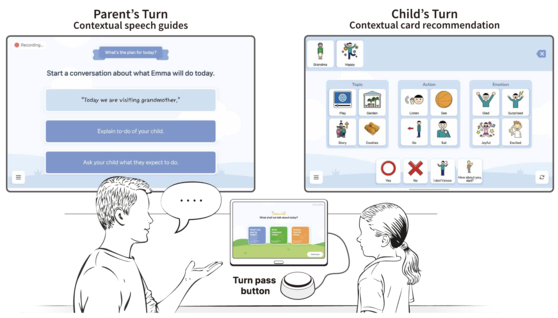
A diagram on how the AACessTalk tool works [KAIST]
A Korean research team has developed an AI communication tool app that facilitates meaningful conversations between minimally verbal autistic children and their parents.
According to a press release on Sunday, Professor Hong Hwa-jung’s team from the KAIST Department of Industrial Design developed “AACessTalk.” This project involved collaboration with Naver AI Lab and the Dodakim Child Development Center.
AACessTalk is a tablet-based AI communication system designed to foster meaningful dialogue that overcomes the limitations of conventional augmentative and alternative communication (AAC) tools, which have been limited to simple card-based communication that fails to fully reflect children’s interests or subtle emotions.
To tackle this issue, the group created a system utilizing artificial intelligence for recommending customized word cards instantly according to the child’s preferences and current circumstances. It also provides parents with targeted conversational guidance suited for every scenario.
The system additionally incorporates elements that provide children with greater autonomy in managing conversations through a button enabling them to decide when to initiate or conclude a discussion. Children can also use a “What about you, Mom?” button to seek their parents’ opinions.
According to the families involved in the study, many kids utilized these features to pose queries to their parents for the very first time in their lives.

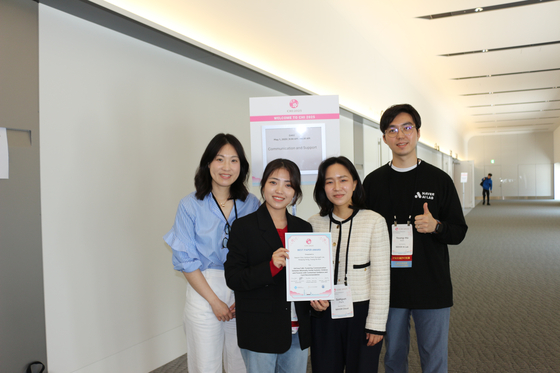
Starting from the left: Professor Hong Hwa-jung who is affiliated with the Department of Industrial Design, PhD candidate Choi Da-som also from the Department of Industrial Design, Researcher Park So-hyun from Naver AI Lab, and Lead Research Scientist Kim Young-ho from Naver AI Lab. [KAIST]
During a two-week field experiment with 11 families, parents moved away from their usual, monotonous ways of communicating by utilizing AI-provided conversational recommendations, which led to deeper discussions. Similarly, children became more expressive and proactive in these exchanges.
“I was surprised when my child used an unexpected word, and it helped me understand their language abilities more deeply,” said one parent.
“Creating an environment where children can express their own voices is more important than anything else,” said Prof. Hong. “This study confirmed that AI can not only improve the efficiency of communication but also serve as a tool to foster genuine connection and understanding within families.
“Our team will continue developing human-centered technologies that respect and embrace neurodiversity,” she said. “In particular, we aim to expand research focused on user experience and the practical application of technology for marginalized communities.”
This research was the result of doctoral student Choi Da-som’s internship at Naver AI Lab while studying at the KAIST Department of Industrial Design.
The research received the Best Paper Award at the ACM Conference on Human Factors in Computing Systems 2025 held in Yokohama, Japan from April 26 to May 1.
BY KIM MIN-YOUNG [kim.minyoung5@joongang.co.kr]