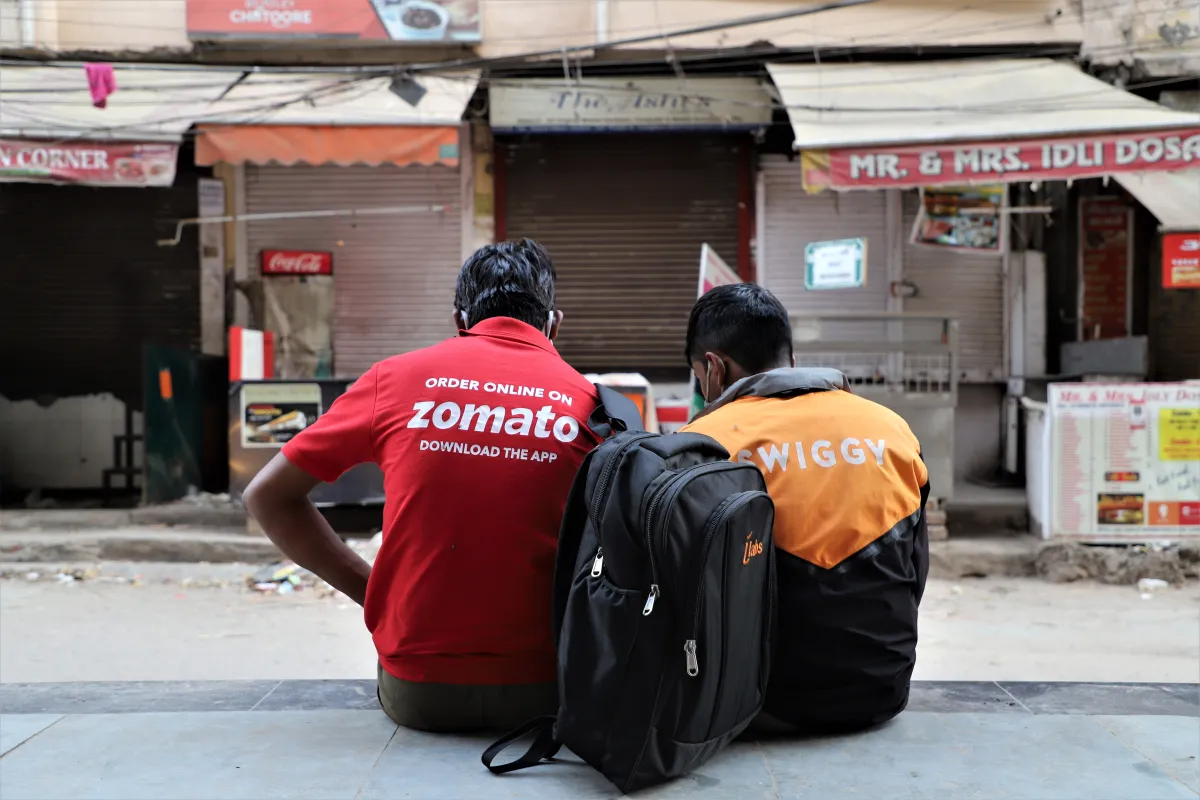
India has officially recognized millions of gig and platform workers through its newly implemented labor laws, a significant shift for the nation’s delivery, ride-hailing, and e-commerce sectors. However, as benefits remain unclear and platforms evaluate their responsibilities, many workers still find themselves without access to social security.
This recognition comes from the Code on Social Security, one of four labor laws the Indian government rolled out last Friday, more than five years after parliament first approved them in 2020. It’s the lone part of the new framework that addresses gig and platform workers, while the other three codes—focused on wages, industrial relations, and workplace safety—don’t provide minimum earnings, employment protections, or workplace guarantees for this rapidly growing workforce.
India is home to one of the largest and fastest-growing gig economies globally, with estimates suggesting more than 12 million people involved in food delivery, ride-hailing, e-commerce, and other on-demand jobs on digital platforms. This sector has become crucial for employment, particularly for young and migrant workers who struggle to find formal jobs, and it’s expected to continue growing as companies enhance logistics, retail, and local delivery services.
Big players like Amazon, Walmart-owned Flipkart, and Indian rapid-delivery apps like Swiggy, Blinkit, and Zepto, along with ride-hailing companies like Uber, Ola, and Rapido, rely on gig workers. Yet, despite fueling some of India’s most valuable tech enterprises, most gig workers operate without traditional labor protections and lack access to essential social security.
The newly implemented labor laws aim to change this by legally defining gig and platform workers and requiring companies like food delivery and ride-hailing platforms to contribute 1–2% of their annual revenue (capped at 5% of payments to these workers) to a government-managed social security fund. However, specifics regarding which benefits will be provided, how workers will access them, and how contributions will be monitored across various platforms remain uncertain, raising concerns that substantial protections could take years to realize.
The Code on Social Security establishes a legal framework to cover gig workers under schemes like the Employees’ State Insurance, provident fund, and government-backed insurance. However, the specifics about the extent of these benefits—such as eligibility, contribution levels, and delivery methods—are still ambiguous and will depend on future rules and notifications.
A critical aspect of this framework is the creation of Social Security Boards at both central and state levels, responsible for designing and overseeing welfare schemes for gig and platform workers. The central board is mandated to include five representatives from gig workers and five from companies, all appointed by the government, alongside senior officials and experts. Yet, clarity is lacking regarding decision-making processes, the influence of worker representatives, and overall management of funding and benefit distribution.
“We need to wait and see what exactly is in the government’s mind when it comes to implementing the four Codes, and what it hopes to do for gig workers,” said Balaji Parthasarathy, a professor at IIIT Bangalore and principal investigator of the Fairwork India project. “And then we have to see what the states translate on the ground.”
Parthasarathy emphasized that since labor policy in India is shared between the federal and state governments, state authorities are responsible for designing and administering many necessary schemes to make the Code on Social Security effective for gig workers. This creates potential disparities in access, as some states may swiftly establish social security boards while others might stall due to political or budgetary obstacles. Recent examples—like Rajasthan’s delayed legislation and Karnataka’s promptly enacted Gig Workers Act—illustrate how protections for workers may depend on their location rather than the law itself.
Platform companies have largely welcomed the reform but are still weighing what it means for them. An Amazon India representative stated the company supports the intention behind the overhaul and is assessing the necessary changes. A spokesperson for Zepto described the new labor codes as “a big step toward clearer, simpler rules that protect workers while supporting ease of doing business,” stating that these changes will strengthen social security for delivery partners without sacrificing operational flexibility.
Food delivery company Eternal, formerly Zomato, noted in a stock exchange filing that the Social Security Code is a move toward uniform regulations and does not expect a significant financial impact on its long-term operations.
Nevertheless, Aprajita Rana, a partner at corporate law firm AZB & Partners, pointed out that the reform “will naturally have a financial impact” on India’s e-commerce sector due to the formalization of worker contributions. This will also impose new compliance requirements, compelling companies to ensure all workers are registered with the government-managed fund, identify individuals linked with multiple platforms, and establish internal grievance mechanisms.
“While the law has the right intent, gig worker structures in India are quite novel, and practical compliance challenges will arise as the law takes effect,” Rana told TechCrunch.
One of the major obstacles for gig workers seeking benefits under the new legislation will be registering on the Indian government’s E-Shram portal, launched in 2021 to serve as a national database for unorganized workers. As of late August, the portal had registered over 300,000 platform workers, while the government estimates that India has about 10 million gig workers. Trade unions like the Indian Federation of App-Based Transport Workers (IFAT), which has over 70,000 members, are actively helping gig workers sign up for benefits.
Ambika Tandon, a PhD candidate at the University of Cambridge and an affiliate of the Centre of Indian Trade Unions (CITU), expressed concern that registering on the portal could mean lost wages for gig workers, who may need to take time off to complete necessary details.
“These workers work for 16 hours a day,” she told TechCrunch. “They don’t have time to go and register themselves on the government portal.”
CITU is also among the major Indian trade unions advocating for the withdrawal of the new labor laws, with nationwide protests planned for Wednesday.
Tandon stressed that the benefits of signing up for the E-Shram portal are not compelling for many gig workers, as the law does not address immediate issues like fluctuating incomes, account suspensions, and abrupt terminations—concerns that are often prioritized over access to insurance or provident fund benefits.
Trade unions frequently organize strikes to demand that platforms directly address these issues, but such actions can disrupt operations and put workers at risk, as they forgo pay while striking and may even face termination for participation.
“While the social security rules are now in place, we demand a minimum wage and an employer–employee relationship for gig and platform workers, which the government has yet to establish,” said Shaik Salauddin, founder president of the Telangana Gig and Platform Workers Union (TGPWU), which has over 10,000 members in Telangana, and national general secretary of IFAT. “We urge the government to gather data from aggregators and secure their financial contributions to the fund to start providing benefits to workers.”
A broader debate exists regarding whether gig workers should be classified as employees—a question the new labor laws do not tackle. The Social Security Code categorizes gig and platform workers separately, instead of extending employee rights and protections to them. In contrast, courts and regulators in markets like the U.K., Spain, and New Zealand have shifted toward recognizing platform workers as employees entitled to minimum wages, paid leave, and other benefits. Similarly, in various U.S. jurisdictions, there are pushes to classify platform workers as employees or provide similar protections, though many ride-hailing and delivery drivers continue to be labeled as independent contractors.
“With this law, the Indian government has settled this debate by stating that these gig workers do not fall under employment or other protections,” Tandon said.
The Indian labor ministry did not respond to a request for comment.