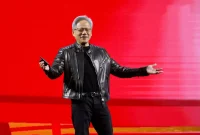
Jensen Huang, the CEO of Nvidia and a key player in the worldwide artificial intelligence transformation, stated that the firm intends to develop up to $500 billion worth of AI infrastructure in the U.S. within the coming four-year period.
His comments coincided with President Donald Trump renewing his push to decrease the U.S. trade deficit and repatriate manufacturing by introducing tariffs on imported goods.
NVIDIA’s components rely on an intricate supply chain involving factories, memory providers, and assembly companies.
As South Korean firms such as SK Hynix — which supplies high-bandwidth memory (HBM) to Nvidia — anticipate gains from this investment, experts suggest that Taiwan may be the primary beneficiary due to its robust AI infrastructure.
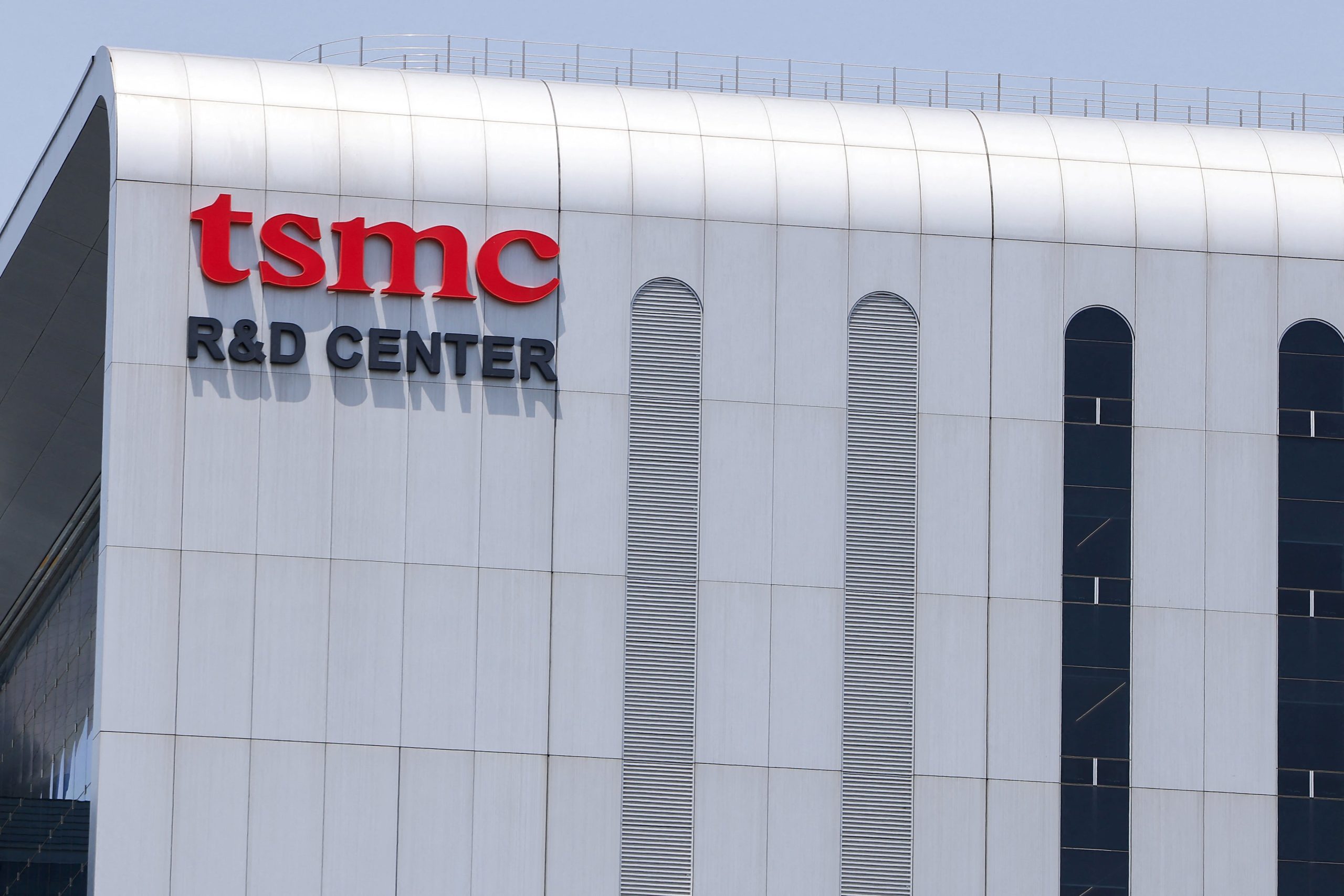
Taiwan Semiconductor Manufacturing Company (TSMC), the foremost producer of semiconductor chips globally, has established nearly complete control over the manufacturing of Nvidia’s artificial intelligence graphics processing units (GPUs). This situation solidifies TSMC’s role as a key figure within the international supply chain.
Driven by the surge in demand for artificial intelligence technologies, TSMC saw its revenues and operational profits increase by 33.9% and 43.5% respectively in 2023 compared to the prior year. The firm has commenced production of Nvidia’s newest AI processor, referred to as Blackwell, at its plant located in Arizona.
Nevertheless, TSMC represents only a segment of Taiwan’s comprehensive AI environment. The country has developed an extensive system encompassing firms like MediaTek, specializing in designing AI chips for embedding purposes, and Quanta Computer, focused on producing AI servers.
Huang recently revealed that Nvidia is collaborating on a joint venture with MediaTek, which is Taiwan’s leading designer of chips. Established in 1997, MediaTek previously provided modems for Samsung Electronics at lower tiers. Now, the firm has grown into an essential partner for Nvidia, showcasing the technological prowess necessary to succeed in the age of artificial intelligence.
Taiwan’s rise in the AI world has also been fueled by government support. During a major IT expo held in the country last year, President Tsai Ing-wen credited the country’s scientific community for helping transform Taiwan into a hub of the AI revolution.
The government has been actively involved in driving this change. It initiated “Taiwan AI Action Plan 1.0” in 2021, setting up artificial intelligence research hubs at key educational institutions. By 2023, under “Action Plan 2.0,” the aim was to educate and produce around 600 research specialists and approximately 8,000 skilled technicians each year.
To reinforce this dedication, the government recently introduced a five-year plan titled “The National Talent Competitiveness Leap Program.” This program seeks to develop 200,000 artificial intelligence experts by the target year of 2028.
Even though China has achieved notable progress in artificial intelligence, the United States continues to maintain a strong advantage.
In the previous year, investments from the private sector into artificial intelligence within the United States exceeded those made by China by over tenfold. As the American market emerges as the central battleground for AI rivalry, South Korea finds itself grappling with numerous challenges ranging from developing leading experts to supporting groundbreaking new businesses.
Worsening the situation, the nation’s scarce reservoir of artificial intelligence specialists is progressively moving abroad. According to a study conducted at Stanford University, South Korea is experiencing an intensifying exodus of AI talent, as numerous experts opt to join prominent American technology companies instead. Experts caution that should these tendencies persist, South Korea faces the threat of lagging in the swiftly advancing age of artificial intelligence.