Hyundai has embraced the unique opportunities presented by electric powertrains to create vehicles distinct from their internal combustion counterparts. The 2026 Hyundai Ioniq 9 is a three-row SUV that must emphasize spaciousness and hassle-free ownership over avant-garde designs or dynamic driving experiences. Although this approach limits creative expression, Hyundai has infused the Ioniq 9 with a futuristic aesthetic, leveraging the established E-GMP dedicated EV platform used across its Ioniq lineup and the Kia EV9. The popularity of Kia’s EV9 highlights Hyundai’s need for an all-electric three-row model, even alongside its existing gasoline-powered three-row SUVs.
### Innovative Design
Many automakers adopt a cohesive design language across their models, but Hyundai has chosen a diverse approach with its Ioniq EV series. The Ioniq 5 and Ioniq 6 showcase contrasting styling, and the Ioniq 9 embraces yet another unique direction, setting it apart from other SUVs in the segment.
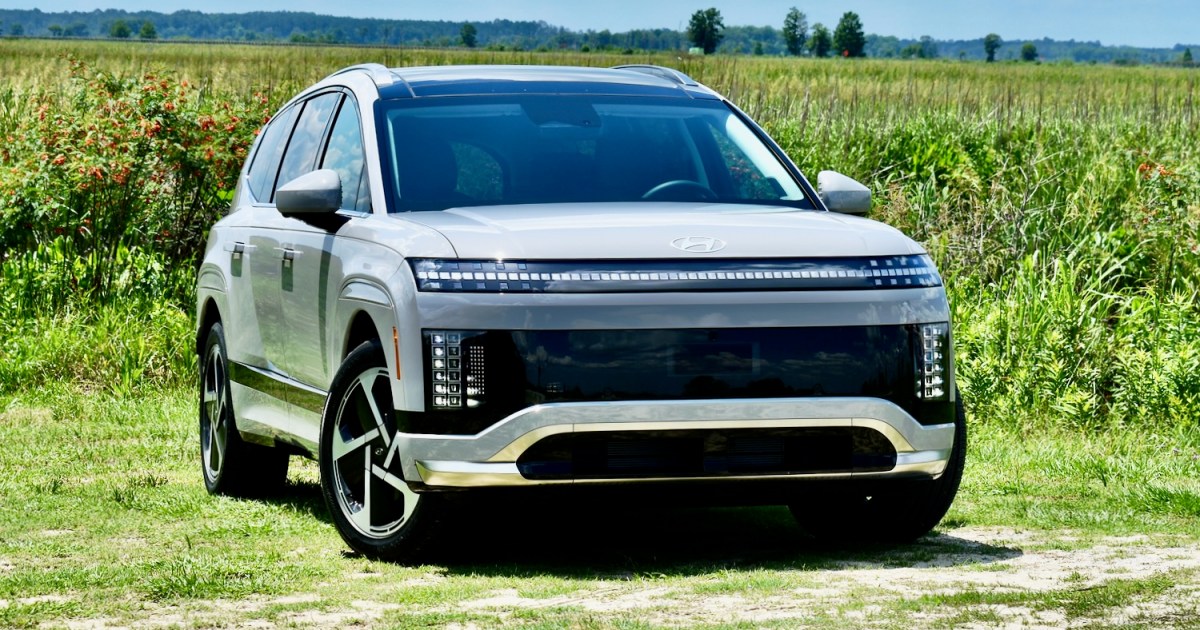
The attention to aerodynamics is evident, as the Ioniq 9 combines low drag with the upright silhouette characteristic of an SUV. This design makes it appear almost futuristic, reminiscent of a vehicle from a sci-fi landscape. The SUV’s robust front end features a high hood, while the streamlined body minimizes air resistance. Squared-off fenders contribute to a rugged look without disrupting aerodynamic flow. The rear displays a tapering design and a truncated tail, echoing the distinctive characteristics that made the 2004 Toyota Prius memorable for its aerodynamic efficiency.
The Ioniq 9 also incorporates pixel lighting, a feature first seen in the Ioniq 5 and Ioniq 6. A light bar running across the front enhances its modern appearance, particularly noticeable in reflective surfaces, while the rear lights form a distinctive ring around the tailgate, adding visual intrigue to the vehicle’s sleek profile. However, the extensive use of black plastic trim may seem out of place, appearing somewhat hastily applied. This material, particularly in interior settings, tends to collect fingerprints, detracting from the overall polish of the design.
### Practical Family SUV
Hyundai has not only made a stylistic statement with the Ioniq 9 but has also designed it using the same E-GMP architecture that forms the basis of the Kia EV9, albeit in a different aesthetic. The Ioniq 9 slightly eclipses the Kia model in dimensions, being 2.0 inches longer, 1.6 inches taller, and a marginal 0.1 inch wider.
In terms of passenger comfort, headroom and legroom are roughly comparable across both models. Hyundai accommodates different needs with options for a second-row bench or captain’s chairs, allowing configurations for six or seven passengers. The second-row seats can slide forward and back, but rear-seat occupants may find limited knee room in the third row, even when the seats are moved to their most forward position. Nonetheless, the space is adequate for younger riders.
The Ioniq 9 features a standard power tailgate that opens to reveal 21.9 cubic feet of cargo volume. This expands to 46.7 cubic feet with the third row folded down and a generous 86.9 cubic feet when both the second and third rows are down, surpassing the Kia EV9’s numbers in all configurations. Hyundai claims more cargo space behind the second and third rows than the Rivian R1S, although Rivian lacks comparable figures for confirmation. However, the Ioniq 9’s front trunk is limited, containing only enough space to accommodate charging cables.
### Performance and Driving Experience
For the 2026 model year, Hyundai offers three powertrain options, each utilizing a 110.3-kilowatt-hour battery. The base Ioniq 9 S features a single rear-wheel drive motor generating 215 horsepower and 258 lb-ft of torque. The SE and SEL trims upgrade to a dual-motor all-wheel drive system, outputting 303 horsepower and 446 lb-ft of torque. The higher-end Limited, Calligraphy, and Calligraphy Design versions employ a performance-oriented dual-motor configuration, producing 422 horsepower and 516 lb-ft of torque.
While the rear-wheel drive variant of the Ioniq 9 shares performance specifications with a similar EV9 model, the high-end Hyundai variant offers slightly more power. It accelerates from zero to 60 mph in 4.9 seconds—just a tenth faster than its Kia counterpart. However, this performance may shift once the more potent EV9 GT model is introduced later this year.
The quick acceleration is beneficial for highway merging, though it’s not the central appeal of the Ioniq 9. Rather, it is designed as a spacious and comfortable SUV, tailored for families navigating everyday tasks. The suspension efficiently smooths out road imperfections without excessive bouncing, and the cabin remains notably quiet aside from minimal tire noise.
The i-Pedal brake-control system enhances comfort by seamlessly blending regenerative and friction braking, delivering smooth deceleration. While the capability for instant regenerative braking exists through paddle shifters on the steering wheel, the system’s default performance is especially refined in the Ioniq 9.
### Charging Capabilities and Range
Hyundai estimates a range of up to 335 miles for the base rear-wheel drive S model, 320 miles for the dual-motor SE and SEL versions, and 311 miles for the top-tier Limited, Calligraphy, and Calligraphy Design configurations, all utilizing the more powerful performance setup. This performance translates to an advantage over the Kia EV9, which has lower range figures despite employing a larger battery pack.
For 2026, both Hyundai and Kia are transitioning to the North American Charging Standard (NACS), allowing users access to Tesla’s extensive Supercharger network. This switch is expected to improve charging options, though not necessarily speed. Hyundai estimates that charging from 10% to 80% can be achieved in approximately 41 minutes at a V3 Supercharger, while this time reduces to about 24 minutes at a 350-kilowatt CCS station using an adapter.
With Level 2 AC charging, a complete recharge takes about nine hours and 40 minutes at 11 kW. Like other models based on the E-GMP platform, the Ioniq 9 incorporates bidirectional charging capabilities, though Hyundai has yet to discuss a comprehensive home backup power system.
### A Competitive Electric SUV Choice
Starting at $60,555 for the base rear-wheel drive option, the Ioniq 9 stands as the priciest SUV in Hyundai’s lineup, with higher trims significantly increasing in cost. The all-wheel drive SE and SEL models have starting prices of $64,365 and $67,920, while the luxury Limited, Calligraphy, and Calligraphy Design trims start at $72,850, $76,590, and $78,090 respectively.
Kia has not yet disclosed pricing for the 2026 EV9, though the previous model began at $56,395 with a smaller battery and range than the base Ioniq 9. Hyundai’s trim lineup appears more focused on higher-end models, which might mirror Kia’s approach with confirmed performance variations for the EV9. All Ioniq 9 variants are produced in Georgia and qualify for a $7,500 federal EV tax credit, unlike the EV9.
This pricing approach may serve to differentiate the two brands, but it poses a challenging decision for consumers since both vehicles offer similar features and spacious interiors, backed by generous warranty coverage. While the Ioniq 9 maintains a competitive edge against the Rivian R1S and various luxury three-row electric SUVs, it ultimately provides a solid yet conventional option within the market.