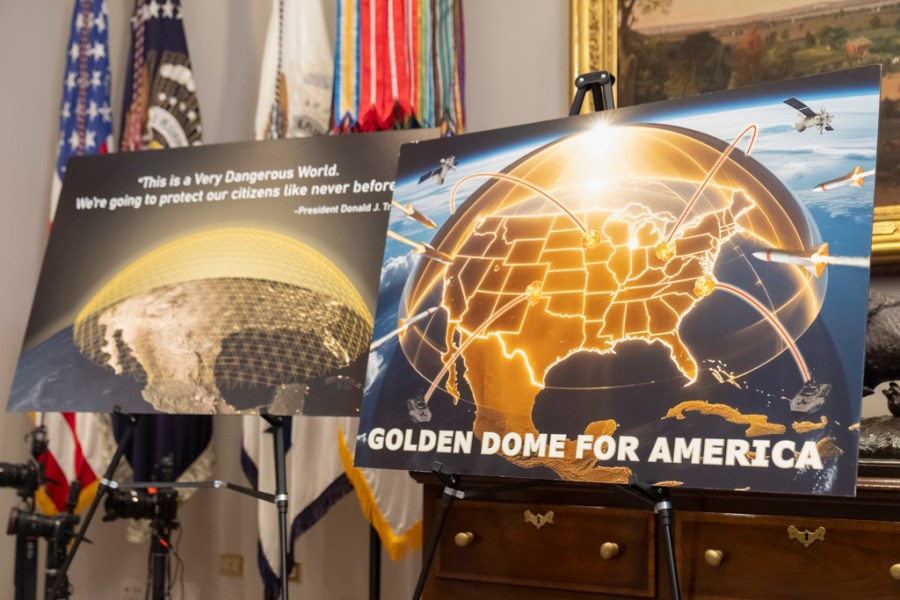
Just over 100 days into his administration, President Trump’s landmark defense initiative is showing signs of moving beyond the conceptual stage. The
Golden Dome directive
, which directs the Pentagon to create a comprehensive integrated air and missile defense system for the United States, marks the greatest potential change in American defense strategy since the early Cold War.
The Trump administration would benefit by moving quickly to kick-start development and ensure that the U.S. delivers this capability within his time in office, given the scale of the threat the U.S. homeland faces.
Creating a national integrated air and missile defense network, however, is no simple task. The Pentagon must carefully combine new defense providers with the current defense-industrial system, leveraging proven technologies as the base of an innovative, potentially transformational capability.
China is in the midst of the most rapid nuclear modernization of any power since the Cold War. Per the Pentagon, it will field
1,000 nuclear warheads by 2030, and 1,500 warheads by 2035
, placing it at near-parity with U.S. and Russian deployed warheads.
Russia, like China, now fields a series of nuclear-tipped hypersonic weapons, which can evade all but the most sophisticated modern air defenses. Iran has yet to cross the nuclear threshold, but it remains on the
cusp of nuclear breakout
. North Korea has undoubtedly gained valuable technology from Russia as compensation for its military support.
Unlike during the Cold War, when the U.S. confronted only one major nuclear threat, by the mid-2030s it is likely to confront several concurrent nuclear threats of varying sophistication.
Strategic stability through mutual vulnerability is extremely difficult to generate with a greater number of nuclear powers. Moreover, advances in hypersonic weapons have increased an attacker’s ability to hit hardened silos more reliably, while the promise of space-based submarine detection has also increased, potentially jeopardizing the Cold War era’s assurance of a naval second strike.
The Golden Dome program is strategically crucial considering the investments America’s rivals have made in their nuclear arsenals and advances in military technology. Delivering the capability requires the rapid integration of new technologies with proven capabilities to deliver hardware at scale.
A full-scale national air and missile defense system requires technological advances to rapidly and accurately integrate data from multiple ground and space-based early-warning sensors, track incoming targets, discriminate between incoming missiles, warheads, and decoys, and cue interceptors to the right targets. Modern defense-focused technology companies can help in this respect, particularly if they can leverage foreign experiences, namely Israel’s design of its multi-tier interceptor system and Ukraine’s remarkably successful attempts at wartime sensor integration.
Despite this, both the Israeli and Ukrainian models underscore the necessity of advanced equipment. Neither Jerusalem nor Kyiv faces an aerial and missile defense challenge as intricate as protecting the United States. Even if such an integrated system starts by focusing primarily on key large cities and crucial national and military facilities, it still presents a significant undertaking.
It will require a comprehensive ground-based radar network, including very long-range radars, a space-based detection system, and potentially a seabed sensor network to identify hostile nuclear-armed submarines. Thousands of high-performance interceptors are necessary for top-tier targets to make Golden Dome credible, while a variety of low-end interceptors are also necessary, particularly if the threat from Chinese dual-purpose merchant shipping is combined with cheap, plentiful loitering munitions.
Even for a restricted defense system aimed at safeguarding the U.S., the technical and physical intricacies necessitate reliable industry collaborators who grasp the challenges associated with extensive defense initiatives to spearhead such efforts.
The U.S. already has examples that point in the right direction. It combines, for instance, a strategic-level ballistic missile defense system in Lockheed Martin’s C2BMC with a tactical-level air and missile defense system in Northrop Grumman’s Integrated Battle Command System. Naturally, the technology in question will differ in Golden Dome’s case. But there are elements of the current air and missile defense system that can also be directly leveraged, most obviously the Aegis ballistic missile defense system.
Only traditional defense actors have the capacity, technological familiarity and scale potential to create even a limited system.
New technologies obviously have a role. American defense tech firms have pioneered ad-hoc sensor integration platforms, crucial for a common missile and air threat picture. New defense firms have also begun to produce cheaper interceptors, relevant against lower-level munitions threats.
Inexpensive drone aircraft can enhance an advanced system of ground- and space-based sensors. Similarly, autonomous maritime vessels can bolster conventional methods for detecting submarines. However, incorporating these systems effectively relies on partnering with entities that possess prior expertise in this area.
The potential advantages of Golden Dome could be transformative for US foreign and defense policies. It reduces the likelihood of both nuclear and conventional attacks on American soil, thereby allowing significant shifts in how forces are structured and strategies formulated. This leads to a stronger, more enduring approach toward rivals like China. However, implementing Golden Dome necessitates leveraging established players within the defense industry rather than relying solely on cutting-edge technologies to bridge any technological shortfalls in equipment and systems.
Peace through strength is a commonsense maxim. It needs to be followed up with action.
Seth Cropsey is president of Yorktown Institute. He served as a naval officer and as deputy undersecretary of the Navy and is the author of “Mayday” and “Seablindness.” Harry Halem is a senior fellow at Yorktown Institute.
Copyright 2025 Nexstar Media, Inc. All rights reserved. This material may not be published, broadcast, rewritten, or redistributed.
To stay updated with the newest information on news, weather, sports, and live videos, visit The Hill.