Spoilers for “The Interstellar Song Contest.”
No, really, spoilers from here on out.
Much like Eurovision itself, that was
a lot
, wasn’t it?
And much like every other episode this season, “The Interstellar Song Contest” was overstuffed, excessive and brutally short. It was also a lot of fun, even if the sheer volume of plot that I wish we’d had more time to explore remains frustrating. Unfortunately, it looks like the great qualities of this episode will be overshadowed by all of the dramatic lore reveals. As usual, head to Mrs. Flood Corner for the analysis, but let’s talk about the rest first.
Eurovision?
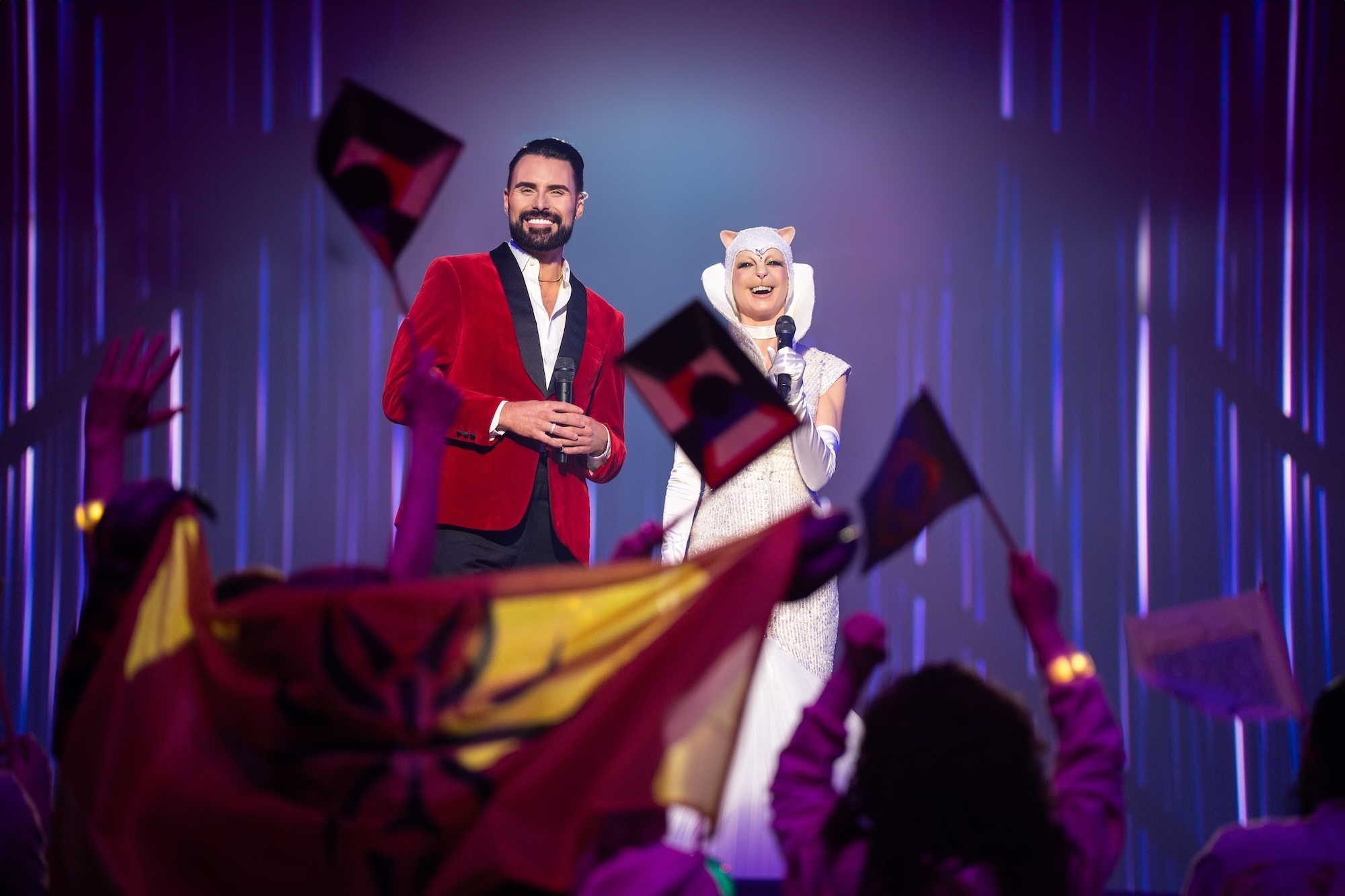
If you’re in the US, you may not be familiar with the Eurovision Song Contest, even if Netflix did make a movie about it. It’s an annual music competition that began in the post-war years that saw the major nations of Europe select an act and a song to compete. Judges from each nation would then rank each performance, with the winning act’s nation going on to host the event the next year. Despite the name, participation isn’t limited to Europe, with entries from Oceania, Africa and the Middle East. And the event, to use a technical term, is
Extremely Gay
, playing up its camp excesses and offering a space for queer performers.
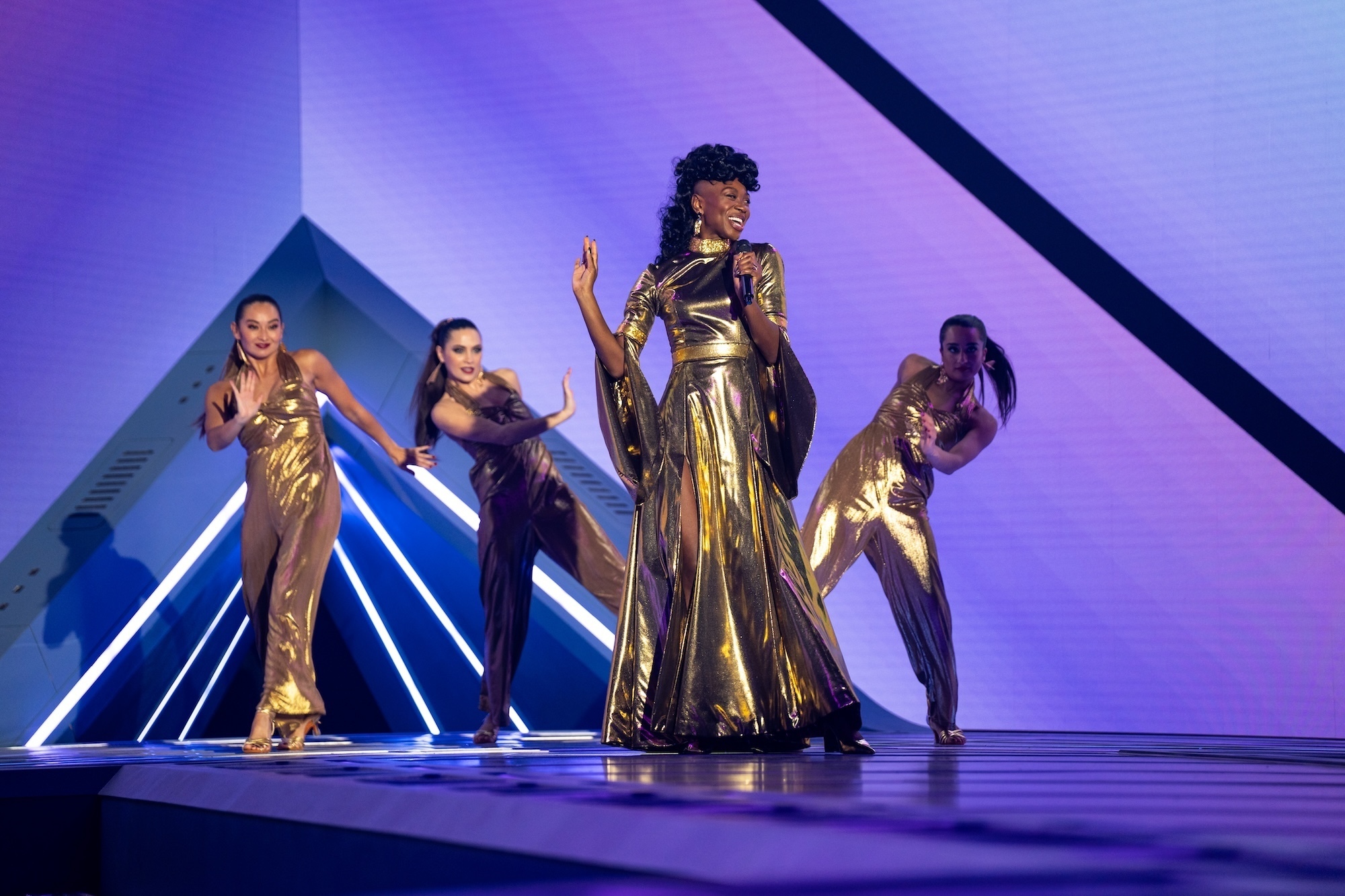
“Did you just fly through space on a glitter cannon?”
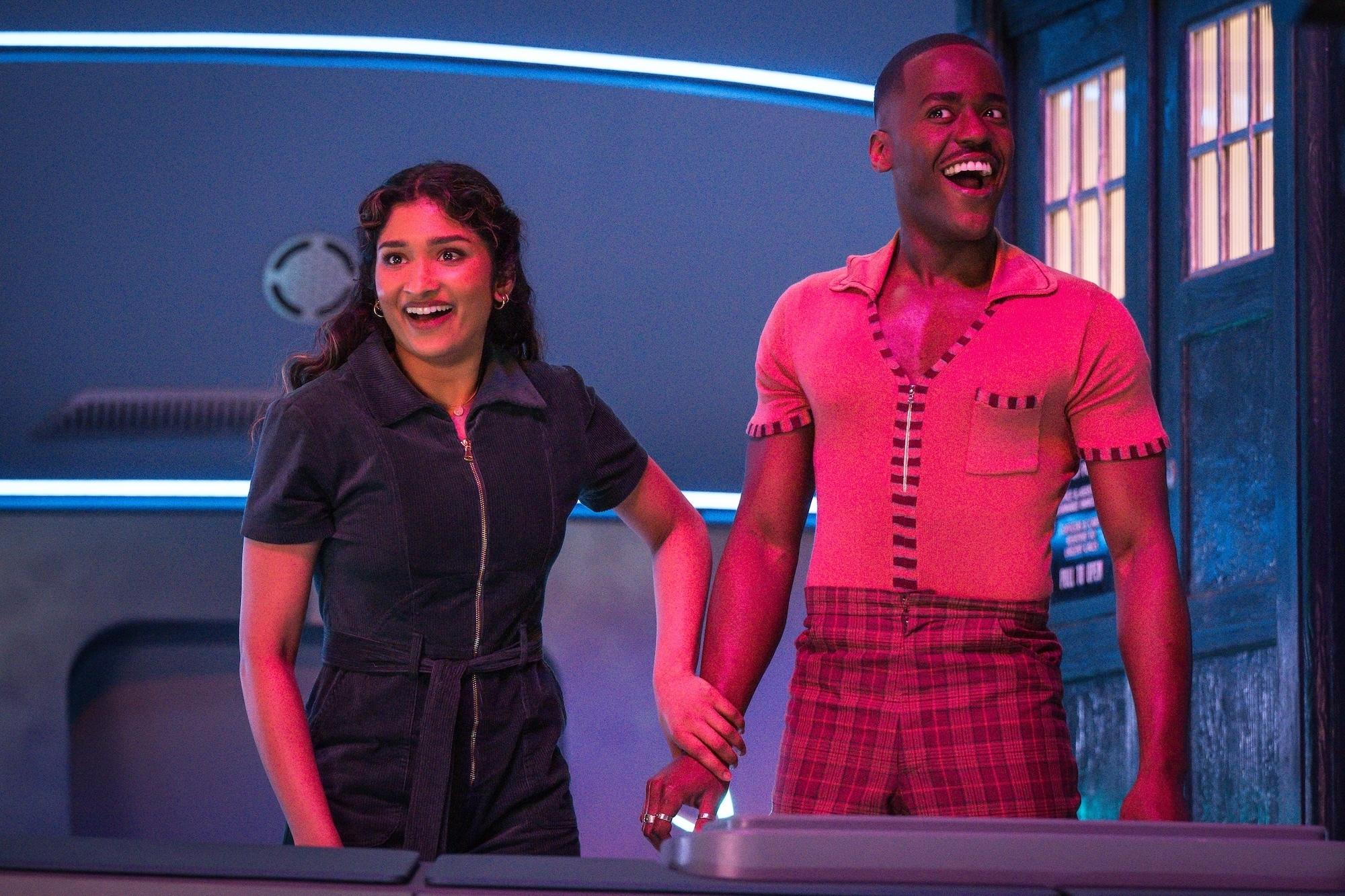
The Doctor and Belinda arrive in a VIP box in the Harmony Arena, a large open-air (given it’s in space, should that be an open-space?) venue. They’re just in time to see the start of the 803rd Interstellar Song Contest, presented by (actual British TV presenter) Rylan Clark, who has just emerged from a cryogenic chamber. The Doctor takes the Vindicator reading, and has enough data to force the TARDIS back to Earth on May 24, 2025 — but the pair decide to stay and enjoy the show. Watching from afar, Mrs. Flood delights that the Vindicator is now primed and ready, but will stay around to watch the show as well.
It’s a popular event, with three trillion viewers from around the universe watching the show, as it’s broadcast much like a TV show. Unfortunately, the production gallery is stormed by Kid, a terrorist who has hijacked the arena’s security drones with help from Wynn, someone from the production crew. Kid and Wynn are both Hellions, a race of beings with prominent devil horns that are reviled across the galaxy for how they look. People assume they are evil, engage in cannibalism and witchcraft, and it’s hard for them to get jobs. The show’s director even says that they were advised against hiring Wynn because she’s a Hellion.
Kid switches the broadcast to the rehearsal feed, which didn’t feature Rylan, which piques the Doctor’s interest as there’s a TV in their VIP box. He pulls out his sonic screwdriver and starts fiddling with the equipment, but as he’s doing so, Kid opens the air bubble separating the arena from the void. And instantly, almost 100,000 people in the audience are
blown
into space, including the Doctor and the TARDIS, while Belinda is saved by the canopy’s roof closing. Wynn closes the canopies to protect the life of Cora, the odds-on favorite to win and the show’s star act. The director notices that the people may be frozen, but they’re trapped within the station’s mavity bubble and could therefore be rescued.
The Doctor, knocked out and frozen,
floating
In the emptiness of space, he wakes up with a vision of Susan (!) inside the TARDIS urging him to “find me.” As he opens his eyes, he notices a glitter cannon nearby and uses it to propel himself towards the station’s airlock.
Wall-E
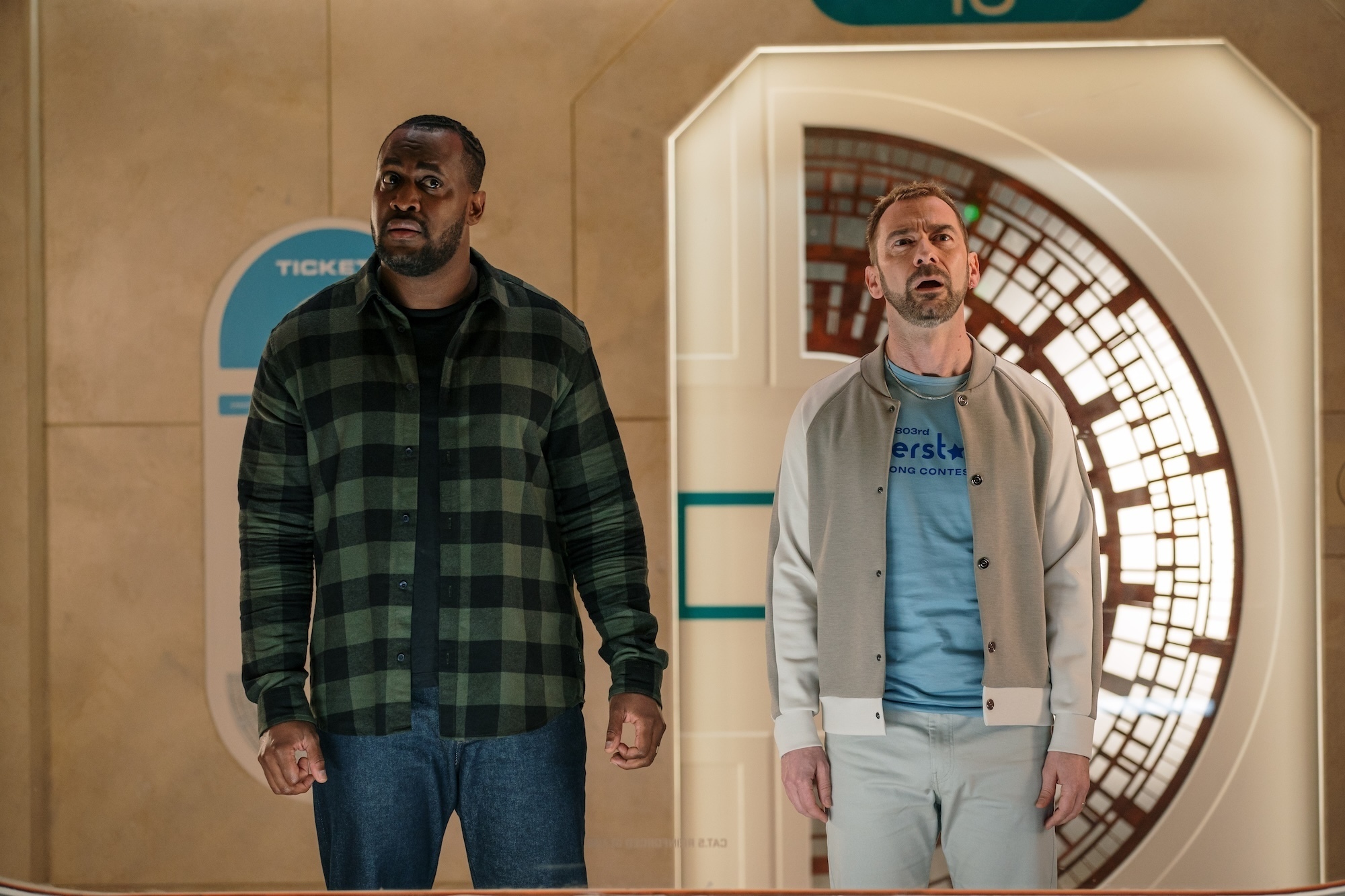
It’s during this encounter that he meets Mike and Gary, the duo whose VIP booth he accidentally took over. Fortunately for everyone involved, they were safely standing in the hallway just as the ceiling began to open up. With assistance from these newfound companions, the Doctor begins deciphering Kid’s subsequent move: transmitting a delta wave through the broadcast signal directly into the minds of all three trillion spectators. This pulse proved potent enough to send the Doctor crashing down onto the ground with blood streaming from their nostrils, and it poses an imminent threat capable of causing fatalities across the entire audience.
Kid and Wynn are taking action because their homeland, Hellia, has been acquired by the same company sponsoring the singing competition. This planet once housed a special type of poppy capable of producing honey-flavored extracts. Upon purchasing the planet, the corporation seized these poppies and destroyed everything else—including the inhabitants. As a result, the Hellions faced widespread dispersal and persecution, becoming pariahs shunned by much of what they considered “civilized” society. By aiming to eliminate everyone watching during an event backed by said corporation, Kid believes revenge can be exacted for past injustices.
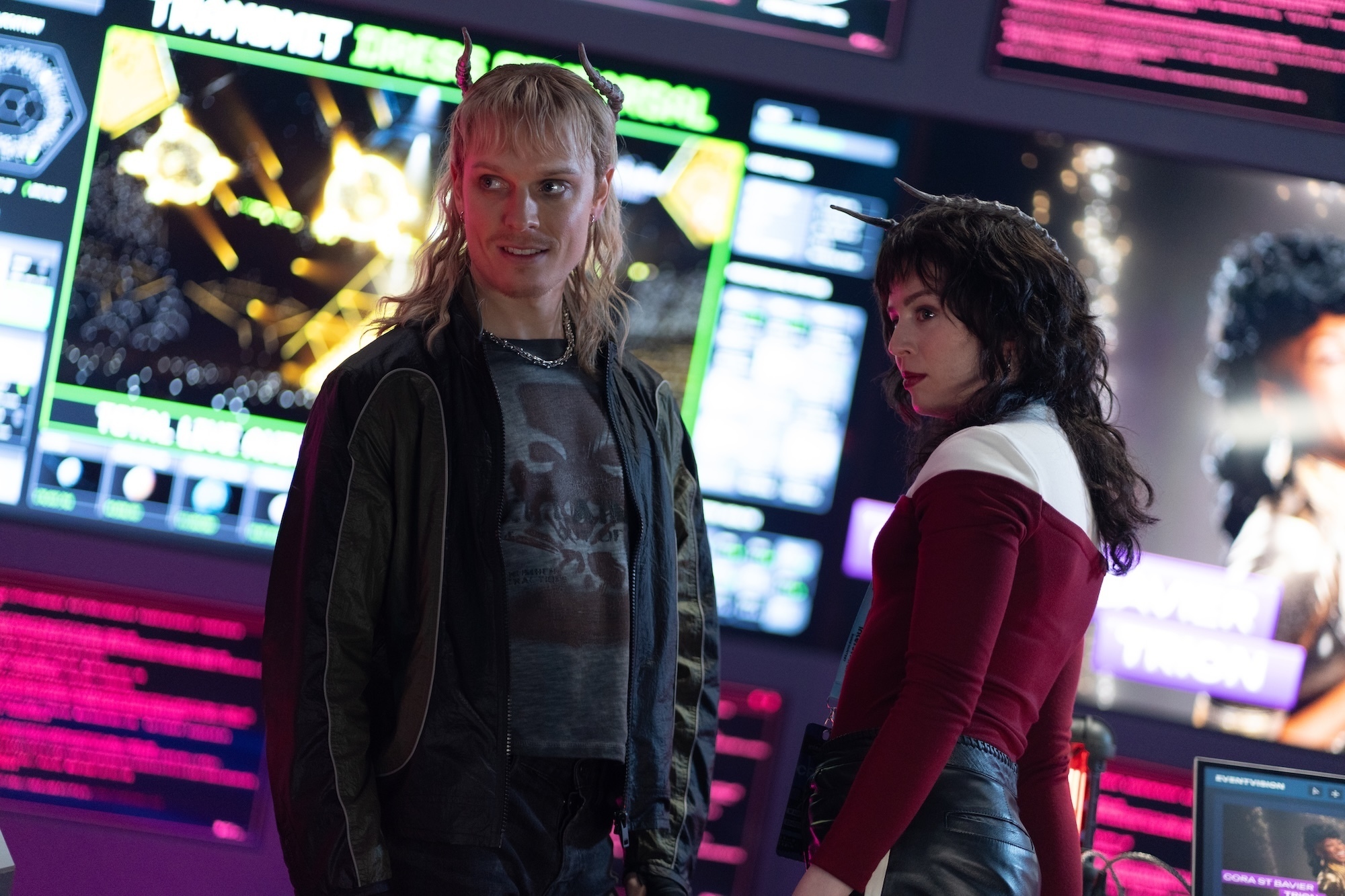
Belinda ends up with Cora, who is the main attraction of the show (and her companion). Together, they manage to breach the system to uncover what’s happening. Believing the Doctor to be deceased, Belinda feels deep regret for not telling him how amazing she found him to be. Fortunately, they gain access to the space station’s video-calling technology and witness the Doctor interacting with Kid through one such communication link. In this interaction, the Doctor demonstrates his intense anger towards Kid—a side of him that surprises Belinda. Cora shares a personal revelation as well; post-call, she discloses that she too belongs to the Hellions but had removed her horns earlier to blend into high society, which led her to become famous.
The Doctor utilizes the station’s holographic capabilities to manifest himself within the production gallery. As Kid fires at the projection, this allows sufficient time for the genuine Doctor to enter unnoticed, effortlessly disabling both Kid’s weapon and the delta wave apparatus. Subsequently, the Doctor channels the station’s energy via his holographic form to administer electric jolts to Kid. He declares that Kid has instilled “coldness” in his heart and will reciprocate the intended mass killing of three trillion beings with an equal number of electrical shocks as punishment. Upon entering, Beinda witnesses the Doctor effectively tormenting Kid, while also experiencing hallucinations where Susan implores him to cease his actions.
Once Kid and Wynn are securely confined, the Doctor devises an alternative method for utilizing the holograms—a tractor beam. Through a series of scenes showing individuals being drawn from nothingness and revived, we witness this process begin with Rylan’s cryonic facility and later expand within a VIP lounge setting. Soon enough, everyone returns, including Cora who steps onto the stage next. She narrates her tale and performs a melody originating from Hellia; despite initial animosity from the spectators, she ultimately gains their approval through her performance. Amidst the ovation, the Doctor and Belinda make their way back to the TARDIS, though not without encountering a holographic version of Graham Norton—the renowned chat-show host and prominent figure at the BBC—first.
Eurovision
— tells them the Earth was destroyed in mysterious circumstances on May 24th, 2025.
The Doctor and Belinda race back, intent on making the TARDIS reach that specific date and resolve whatever problem is approaching. However, despite having the Vindicator connected, the TARDIS remains uncooperative, sounding the Cloister Bell and shifting to an entirely crimson lighting system. An ominous sound emanates from beyond the door, which the Doctor recognizes as “the sound of May 24th,” just before the TARDIS doors burst open. Then, the credits start rolling.
Just as things start unfolding, the scene cuts abruptly right after showing the initial crew card. We’re brought back to Mike and Gary at Harmony Arena where they manage to resuscitate the most recent individual blasted into outer space—Mrs. Flood. She discloses that both of her brainstems were frozen during her time adrift, which would typically be fatal for someone from Gallifrey; however, she prides herself on being uniquely resilient. Then breaking the fourth wall, she utters “Let battle commence,” before bifurcating into two distinct personas: Mrs. Flood and The Rani portrayed by Archie Panjabi. In this new arrangement, Mrs. Flood takes an auxiliary role under her evolved counterpart. They depart together, with The Rani declaring her intention to instill ‘utter dread’ upon the Doctor. When Mrs. Flood suggests that fear has already been achieved once, The Rani instructs her to remain silent.
I would do anything for you, Doctor.
Honestly,
Doctor Who
can sometimes be a bit like a teddy bear with a razor blade hidden under its palm. Sure, it may look lightweight and cuddly, disarming you with its charm, but then it’ll cut you so deep you won’t even realize. “The Interstellar Song Contest” is, without a doubt, one of the most affecting episodes in the run. This episode comes less than a decade after the Manchester Arena bombing that killed 22 people and injured more than a thousand. The visual of the 100,000 people being blown into space was staggering in its brutality. Juno Dawson’s already written for
Doctor Who’s
broader horizon, yet her first screenplay for the television series moves forward
hard
.
But even if it’s a harrowing watch at times, it’s also filled with enough moments of levity. The Doctor’s flirting with married couple Mike and Gary at various points in the episode is delightful as they’re both increasingly smitten with him. The music is delightful, and Cora’s final song was designed to melt people’s hearts, plus there’s a few background gags for the more novelty act songs that appear every year.
Once again, I’m compelled to say the 45-minute format does nothing for Doctor Who when it’s treading this high a wire. The themes of this episode include indifference to evil, pinkwashing, passing privilege, cultural identity, commodification, the inhumanity of replacing customer service with computers, the perpetuation of abuse and the value of revenge. Given Eurovision presents itself as an explicitly queer event, I’m sure better-qualified writers can speak more authoritatively on the episode’s deeper subtext and political themes. And possibly explain in better detail where its sympathies lie.
Each episode this season seems to have contained sufficient content to last for three half-hour shows from the late ’80s.
Who.
Similar to how last week’s episode brought back memories of “Ghost Light” from 1989, this one made me think of “The Happiness Patrol” from 1988. On the surface, that particular episode deals with a world where anyone displaying obvious signs of unhappiness would be immediately executed. However, beneath the surface, it addresses issues such as life in the UK during Margaret Thatcher’s tenure, Operation Condor, and the fight for gay rights. For those interested, further reading can provide more insights.
Elizabeth Sandifer’s essay on the episode
.
Hopefully, too, you’ll notice the thematic parallels that are running through many of these episodes. Conrad in “Lucky Day,” The Barber in “The Story and the Engine” and Kid here are all presented as characters looking for revenge. But while the middle member of that trio has been ostensibly redeemed, the other two crossed the Doctor and made him angry. If his speech to Conrad was full of vitriol, then Kid is the first time we’ve seen Gatwa’s Doctor in full vindictive mode. This has been a recurring theme for most of the post-2005 series, that the Doctor needs to hold themselves back from unleashing their full power and fury.
Mrs. Flood Corner
Doctor Who
was born before the home media age, where episodes were broadcast on a more or less one-and-done basis. If you were a fan looking to revisit an old episode, you had to read the novelizations that started coming out when the show became a hit. But
Doctor Who
wasn’t originally built to support a six decades-long global multimedia franchise, and that’s an issue. When it started, the Doctor was joined on his adventures by his granddaughter, Susan (Carole Ann Ford), and two of her teachers who followed her home one night. Long before any talk of Time Lords or Gallifrey, Susan was just the kid who needed to be rescued every third or fourth week.
Carole Ann Ford was dissatisfied with the limited development of her character and decided to depart in 1964, one year into the series’ run. In “The Dalek Invasion of Earth,” the Doctor faces exile.
his own granddaughter
To the 22nd-century Earth, she goes to kiss a boy. Yet he denies her a proper farewell, sealing the TARDIS doors shut and delivering an address that seems honorable out of context. However, Susan’s poor treatment extends beyond being casually written off the series; it also concerns how her presence aligns—or misaligns—with the narrative established for the show. Given her status as a Time Lord—a nearly immortal form-shifting entity—abandoning her at random due to romantic feelings appears remarkably reckless.
Susan’s presence also prompts inquiries into the Doctor’s other family ties that haven’t been explicitly explored on-screen. Producer John Nathan-Turner succinctly captured the series’ unstated rule with “No romance inside the TARDIS.” However, if the Doctor has a granddaughter, could this imply the possibility of a companion or offspring awaiting their eventual return to Gallifrey after millennia? Despite seeming content with roaming through space and time rather than settling down, the Doctor hasn’t shown interest in these connections either. Apart from a brief cameo in an episode marking the show’s 20th anniversary in 1983, and a photograph seen in the Doctor’s study in “The Pilot,” Susan’s role has largely faded into obscurity.
Until an actress named Susan Twist joined the cast of “Wild Blue Yonder” and later appeared in “The Church on Ruby Road,” things were different. Throughout Ncuti Gatwa’s debut season, Twist made recurring cameo appearances with increasing character recognition. Even “The Devil’s Chord” concluded with a meta-musical sequence titled “There’s Always a Twist at the End.” The narrative strongly suggested that Twist portrayed a regenerative form of Susan, a fact initially mentioned early in that episode. However, by the end of the previous season, it turned out that Twist’s involvement was actually part of Sutekh’s scheme to ensnare the Doctor—a clever misdirection known as a double bluff.
It seems now that showrunner Russell T. Davies has been engaging in an extended game with his audience. Throughout the lengthy and obvious deception spanning the entire season, I found myself genuinely taken aback upon seeing Carole Ann Ford’s visage appear on-screen. Her appearance occurs two times; initially, as the Doctor faces imminent demise, she implores him to “find me” (echoing the plea from Reginald Pye’s spectral spouse who instructed him prior to blowing up the movie reels in “
Lux
The second time, she criticizes him for subjecting Kid to torture due to his planned genocide.
Who is Mrs. Flood?
In numerous aspects, Susan’s presence significantly outshines the revelation that Mrs. Flood is actually the Rani. This adversary from the (classic) series is much lesser known among fans compared to other Time Lords she faced, having only made an appearance in
only two official
stories
During its initial run, the Rani garnered considerable attention from fans when portrayed by Kate O’Mara (who might be most recognized in the U.S. for her role in
Dynasty
) who endowed the character with excessive campiness. This might have dulled the notion that she was akin to a Time Lord version of Josef Mengele, recklessly exploiting individuals as subjects for her horrific tests. Sadly, the Rani was introduced so late in the original series’ run that she appeared again only once, in an episode many fans would rather overlook.
It seems that Russell T. Davies’ secret objective for the streaming age has been to revitalize certain ideas from the ’80s that weren’t successful at the time. Having reintroduced Mel as a UNIT staff member last year, he is now doing the same with the Rani. Notably, these characters were originally developed by Pip and Jane Baker—writers closely associated with the show’s broader downturn prior to its spectacular comeback under Andrew Cartmel. Additionally, it might be significant that “Rani” means “Queen” in Sanskrit; however, this marks the first time an actress of South Asian heritage, namely Sacha Dhawan, will portray the role.
To be frank, at minimum, I’m glad that Mrs. Flood has been revealed as the Rani, just to put an end to people’s speculations.
going on
about that character. It’s not that she’s a bad character per-se, but when the series already has the Master, a renegade Time Lord who concocts elaborate traps for the Doctor, it’s hard to see the Rani as anything other than a “will this do?” alternative. Hopefully the finale can establish a real distinction between the Rani of the classic series and the new one beyond breaking the fourth wall.
… and the rest
Now, I have to apologize last week for not clocking the child Belinda saw in the alleyway was Poppy (Sienna-Robyn Mavanga-Phipps) from “Space Babies.” Obviously, some fan theories have suggested it was a sign that the stories from “The Story and the Engine” were leaking out of the pocket dimension. But at Comic Con Cardiff at the end of last year, Anita Dobson (Mrs. Flood)
said that
the second season would tie into “
Space Babies
,” which was another episode with a similarly fairytale premise.
If that is the case, and everything that has unfolded in the last two years is all part of some grand plan then it must have started at “Wild Blue Yonder.” It’s the second of the three 60th anniversary specials, and the episode that saw David Tennant’s Doctor disrupt Isaac Newton’s discovery of gravity. It’s been a running joke ever since that the force is known as “Mavity,” and that episode is also the one that allowed the pantheon of gods to enter this universe. Given Susan Twist was playing Isaac Newton’s maid, perhaps the series shifted into the Twistverse at that point. Or, you know, the prevailing fan theory that this era takes place in the Land of Fiction, a pocket fantasy universe depicted in 1968’s “
The Mind Robber
.”
One subtle running thread this season has been the Doctor’s almost
insistent urging
That Belinda likes their trips together. He has mentioned several times how Belinda is becoming comfortable traveling with him in the TARDIS and beginning to relax and have fun. If the sole reason he encountered her was
Initially, this was due to Conrad.
, then maybe he’s unknowingly constructing his own trap.
bootstrap paradox
. This would be, as you understand,
a bad thing
.
Ultimately, it seems each episode of this season will mirror the themes of their counterparts from last year. “Dot and Bubble” as well as “The Story and the Engine” delve into how changes in the Doctor’s race impact their experiences. Meanwhile, “Rogue” along with “The Interstellar Song Contest,” explore LGBTQ+ issues within popular culture contexts. Assuming this pattern holds, “Wish World” should unravel complex narratives and build towards a significant climax. Following that would be “The Reality War,” which might struggle to meet expectations set by earlier episodes—much like what happened previously.