It took a while, but Roland finally delivered what everyone has been waiting for: a genuine analog successor to the legendary TR-808 drum machine. The unique sound of the 808, particularly its kick drum, is so ingrained in today’s music that it’s impossible to summarize its impact in just one sentence or a list of artists. (Note: Not all linked songs use an actual 808, but they incorporate samples or versions of its sounds.)
True to its form, Roland didn’t just recreate the iconic analog circuits. The TR-1000 also features digital emulations of other classic Roland drum machines, FM synthesis, PCM samples, and a sampler with looping and chopping capabilities. Plus, it comes packed with effects, sound layering options, and a modern sequencer that includes features like probability, automation, and microtiming. In short, if there’s a feature you’ve ever dreamed of in a drum machine, the TR-1000 likely has it, but it also means that it’s a complex device with a hefty price tag of $2,699.99.
The Good
- 16 amazing-sounding analog drum circuits
- Multiple engines with a vast sound palette
- Plenty of hands-on controls
- Exciting performance-oriented Morph slider
The Bad
- Quite expensive
- May be overloaded with features
- Sampling feels somewhat added in
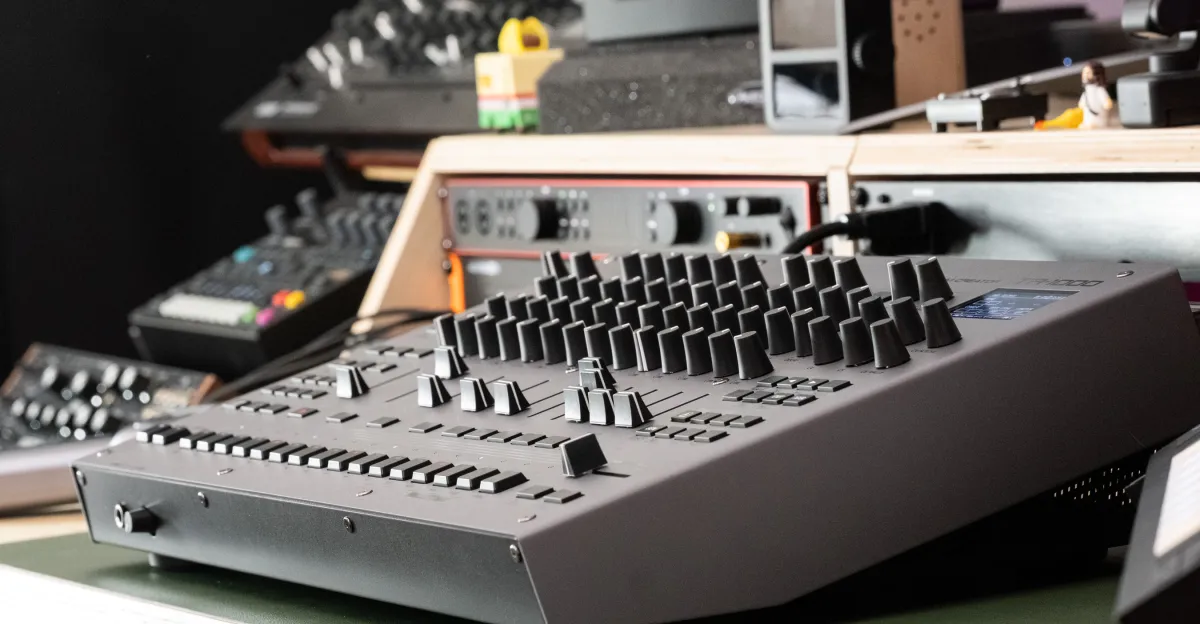
Visually, the TR-1000 can be a bit daunting at first. Historically, Roland has faced criticism for some of its overly flashy designs, and it seems they may have gone the other way this time. The Gaia 2 and SH-4d synthesizers have a utilitarian, even dull aesthetic. The TR-1000, however, strikes a serious note with its robust build.
The stark gray-and-black color combination gives it an industrial, almost brutalist appeal. It features 16 satisfying keys at the base for the step sequencer, solid sliders across its 10 audio channels, and a multitude of buttons and knobs. If you wanted more hands-on controls, Roland has delivered.
One of the standout features is its gritty analog filter. As a result, you can achieve a lot on the TR-1000 without delving deep into menus. If you’ve used a step sequencer before, creating a simple beat is a breeze. There are dedicated knobs for tuning and decay, enabling you to generate that ultra-deep, modern 808 kick sound effortlessly. While some knobs have generic labels (CTRL 1, CTRL 2, CTRL 3), the screen on the top right makes it clear what they control.
That said, some menu navigation is still required—after all, it’s a Roland machine. But the company has made improvements to its user interface over the years. The challenge lies in Roland’s tendency to squeeze every imaginable feature into each device. While having sample chopping and resampling on the TR-1000 is nice, using them isn’t always straightforward, and the setup can complicate the exploration of chops for recontextualizing loops. For one-shot samples and drum hits, it shines, but some more advanced functions feel tacked on and buried under convoluted button combinations and confusing menus. Often, I found myself using the TR-1000 like a traditional drum machine.
From that angle, the TR-1000 is undeniably a success, albeit at a steep price. The hallmark feature is undoubtedly its 16 analog drum circuits that replicate famed sounds from the TR-808 and TR-909. If you aren’t particularly interested in an authentic analog replica of the 808 snare, there are numerous alternatives available, including affordable options like the T-8 from Roland and countless free sample packs. But for those seeking the real deal, this is the moment you’ve been waiting for.
For fans of old-school hip-hop, house, or classic techno, this is the palette to work with. However, I wouldn’t classify the 808 or 909 sounds as retro—they’re timeless. The TR-1000 highlights this by pairing them with a modern sequencer and more aggressively digital sounds.
The 808 bass drum is one of pop music’s most significant innovations since the electric guitar. The analog filter and saturation blend various sounds while emphasizing the grit of the analog drum circuits. Crank up the decay on an 808 kick and adjust the drive to around 75 percent—this is where the magic happens. It’s a sound that resonates deeply and has a way of pulling you back to jam repeatedly.
Roland could have simply replicated the classic 808 and 909 sounds and called it a day, but they went further. In addition to the original tones, there are extended controls that allow for more sound sculpting than what was available on the original machines. For instance, you can tune the 808 kick to be played as a bassline—something that’s become popular in modern music yet typically needs a sampler or synthesizer.
The TR-1000 also showcases the company’s digital emulations beautifully. If you place the analog circuit behavior (ACB) emulation of an 808 kick side by side with the real analog version on the TR-1000, distinguishing the difference becomes challenging. Even with a discerning ear, I struggled to tell them apart in a blind test.
The ACB models showcase some of my favorite Roland sounds. While the allure of the 808 and 909 is evident, I’ve always been drawn to the more lo-fi tones of the TR-606 and the CR-78. If Roland were to release a real analog reissue of those sounds, I’d gladly spend my money on them.
Yet, despite the range of sounds and advanced features available, I often started with a few familiar sounds: an analog 808 kick, snare, hi-hat, clap, an analog 909 snare, and a digital 808 kick layered with the analog one. The other five tracks typically contained random digital percussion sounds that struck my fancy in the moment.
Given the quirks of the TR’s sequencer, I found myself working with shorter, simpler patterns instead of lengthy 64- or 128-step sequences. The TR-1000 has essentially a 16-step sequencer with eight variations and four fill-in versions for each variation. This led me to think in terms of shorter loops, building a range of slight variations to switch between.
This approach encouraged me to create more diverse drum tracks. The numerous hands-on controls allowed me to treat the drum machine as a performance instrument rather than merely a backdrop for improvisation. My go-to performance tool was the Morph slider, reminiscent of the crossfader found on Elektron’s Octatrack. It enables you to set two distinct parameter sets for all sounds and blend between them seamlessly. I typically used it to switch between a basic pattern and a driven version with elevated decay on the kick and enhanced snare tuning.
Another performance-centric feature I enjoyed was the Step Loop function. While many drum machines allow you to repeat certain parts of a pattern, Roland stands out by letting you repeat any chosen steps in any combination. Want to loop steps one, five, and nine without snares? Just hold those steps for as long as you like. This transforms playing fills into an interactive process, as opposed to something you simply program and trigger occasionally. It’s a rare feature I believe should be emulated by other companies.
I’ve had a blast with the TR-1000; it’s brought me more joy in working with a drum machine than I’ve experienced in a long time. Nevertheless, it feels like I’ve only scratched the surface of its capabilities over the past few months. I rarely engage with looping, time-stretching, or chopping features, nor do I delve into the virtual analog synth engine—largely because programming melodic passages can be a pain. Each track has individual outs, which would be invaluable in a professional setting, but in my home studio, I mostly stuck to the master out. I also never used Song Mode, but to be fair, I rarely touch that on any of my equipment.
The sheer amount of features on the TR-1000 can feel overwhelming. Roland has indeed created the ultimate drum machine, but at times, it feels like too much, leading me to stick with the basics. There’s nothing wrong with that; instruments should be used in ways that feel natural to the user. However, if you’re not planning to utilize the TR-1000 to its full potential, the $2,699.99 price might be a deal breaker.