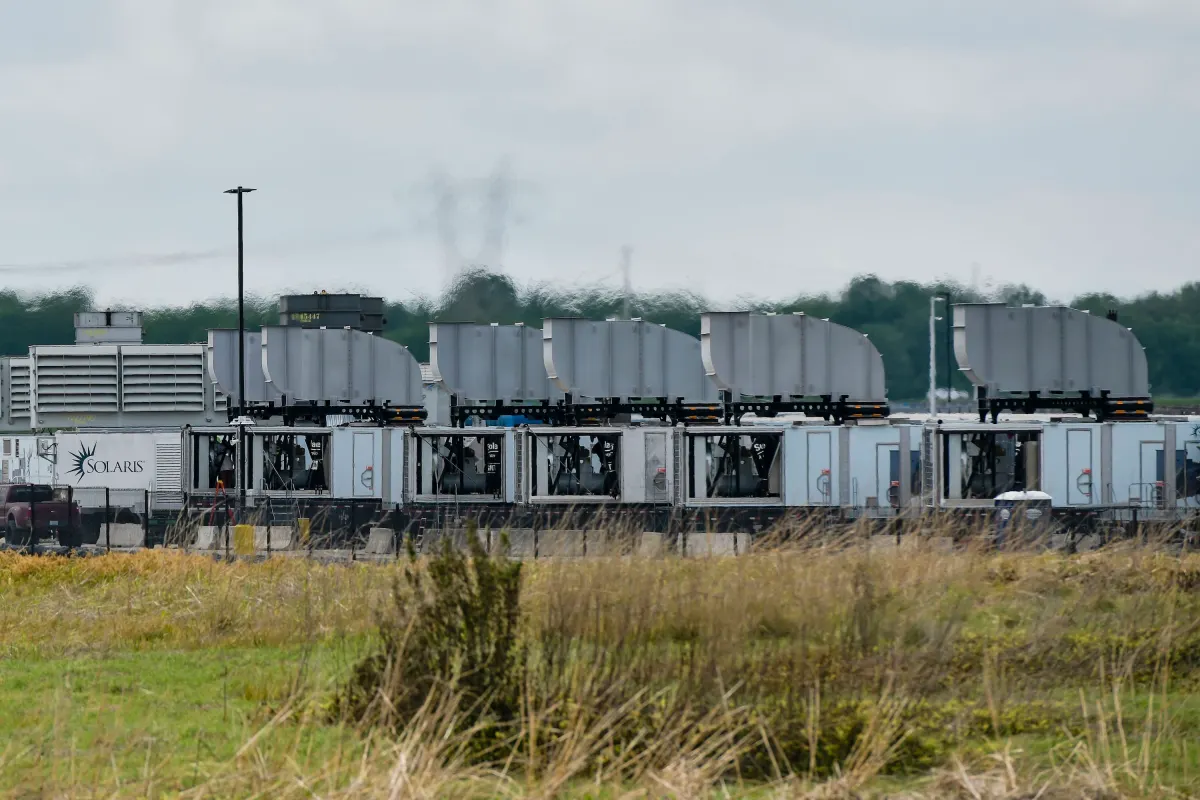
There was a time when most Americans knew very little about their local data centers. Often an invisible but essential part of the internet’s infrastructure, these server farms weren’t a topic of concern for anyone outside the tech industry, let alone a political issue that sparked passion among the general public.
That seems to have changed as we head into 2025.
In the last year, data centers have spurred protests in numerous states, as local activists rise up against the burgeoning number of these facilities. According to Data Center Watch, which monitors anti-data center movements, there are now 142 activist groups across 24 states actively opposing data center projects.
Concerns among activists are varied: the potential environmental and health impacts of these facilities, the controversial implementation of AI, and perhaps most crucially, the effect on local electricity bills from the increasing demand on America’s power grid.
This surge in grassroots activism appears to be a natural reaction to an industry that has expanded rapidly, often showing up uninvited in people’s neighborhoods. As AI technologies have exploded in popularity, so has the cloud computing sector. Recent data from the U.S. Census Bureau indicates that construction spending on data centers has jumped a staggering 331% since 2021, with totals reaching into the hundreds of billions of dollars. Experts warn that with so many new data centers proposed, many may never get built.
The growth of data centers shows no signs of slowing down. Major tech players like Google, Meta, Microsoft, and Amazon have all laid out substantial investment plans for the upcoming year, much of which will likely be funneled into new data center projects.
This push for new AI infrastructure isn’t just coming from Silicon Valley; Washington, D.C., is on board too. The Trump administration has made artificial intelligence a core focus, launching the Stargate Project in January to set the stage for a large-scale AI infrastructure expansion by 2025, touting it as part of a “re-industrialization of the United States.”
As this industry experiences rapid growth, it is increasingly in the public eye—and facing significant backlash. Danny Cendejas, an activist with MediaJustice, has been involved in several protests against data centers, including one in Memphis, Tennessee, where locals rallied against the expansion of Colossus, a project by Elon Musk’s xAI.
Cendejas told TechCrunch that he’s meeting new people every week interested in organizing against data centers in their neighborhoods. “I don’t think this is going to stop anytime soon,” he said. “I think it’s going to keep building, and we’re going to see more wins—more projects getting halted.”
Evidence supporting Cendejas’ view is apparent across the country. Communities often respond to new server farms like one might react to a contagious outbreak. In Michigan, for example, where 16 data center construction sites are under consideration, protesters recently gathered at the state capitol, proclaiming, “Michiganders do not want data centers in our yards, in our communities.” Similarly, in Wisconsin, locals successfully convinced Microsoft to abandon plans for a new 244-acre data center. In Southern California, Imperial Valley has even filed a lawsuit to overturn its county’s approval of a data center project due to environmental concerns.
Discontent regarding these developments has grown so intense that politicians see it as a potential game-changer in upcoming elections. Reports indicate that rising electricity costs—widely believed to be fueled by the AI boom—could play a pivotal role in the 2026 midterm elections.
“The connection between rising energy bills and these projects is what makes this issue resonate with people,” Cendejas stated. “So many of us are struggling month to month. Meanwhile, there’s this huge expansion of data centers…[People are asking] Where is all that money coming from? Why are local governments giving subsidies and public funds for these projects when our communities have pressing needs?”
In some instances, protests have been effective in blocking or delaying planned developments. Data Center Watch claims that grassroots opposition has stymied around $64 billion worth of projects. Cendejas is optimistic that organized action can halt corporate plans. “All this public pressure is working,” he noted, pointing to a palpable anger surrounding the issue.
As expected, the tech industry is pushing back. Recently, Politico reported that a new trade group, the National Artificial Intelligence Association (NAIA), is working to influence lawmakers and organize local “field trips” to help pitch the benefits of data centers to their constituents. Companies like Meta have also launched advertising campaigns aimed at showcasing the economic advantages of data centers. With the tech industry heavily invested in an extensive compute buildout, it seems clear that the data center surge—and the ensuing backlash—will persist into 2026.